Imagine working for 40 years… then doing that again… and again… and still not earning what a CEO makes in just one year.
Sounds extreme, right?
But that’s exactly what recent data suggests.
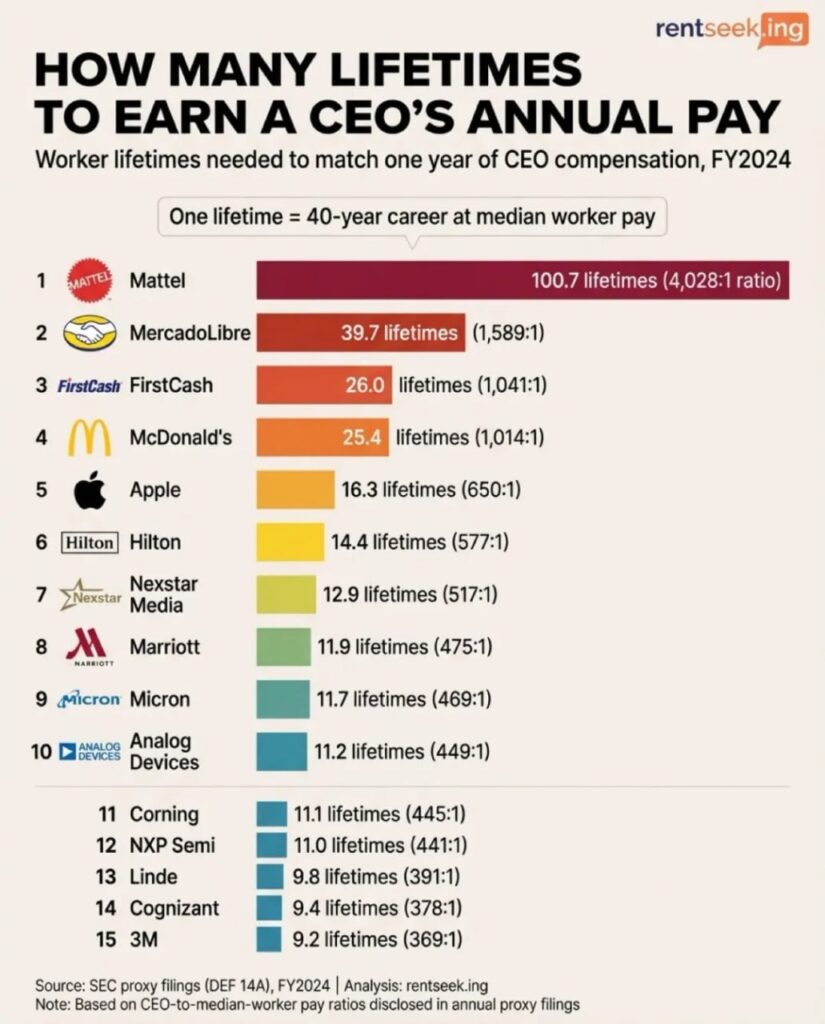
At companies like Mattel, an average worker would need over 100 full careers to match one year of CEO pay.
This isn’t just a statistic. It’s a wake-up call.
What This Really Means
Let’s simplify it.
A “lifetime” in this chart means:
- 40 years of work
- At average employee pay
So when you see:
- 16 lifetimes at Apple
- 25 lifetimes at McDonald’s
It means:
“If you worked your entire life, you’d need to repeat that life many times to earn what the CEO earns in one year.”
The CEO of Mattel earned more in one single year than you would earn in 100 lifetimes.
That’s not 100 years. That’s 100 entire careers of 40 years each. That’s 4,000 years of working — just to match one year of their pay.
But Don’t Misread This
This is where many people get stuck.
They see this and think:
- “The system is unfair”
- “There’s nothing I can do”
- “Success is out of reach”
That mindset will keep you exactly where you are.
Because here’s the truth:
 CEOs are not paid for time They are paid for scale, decisions, and impact
The Real Lesson Hidden in This Data
This chart is not just about inequality.
It’s about how money actually works at the highest level.
Employees earn:
- Based on time
- Based on tasks
- Based on fixed roles
CEOs earn:
- Based on decisions
- Based on company performance
- Based on ownership (stocks, equity)
That’s a completely different game.
What You Should Do With This Information
Instead of getting discouraged, use this as a strategy shift.
1. Stop thinking only in salaries
A salary has a ceiling.
Even a high-paying job still ties your income to time.
2. Learn high-value skills
Focus on skills that influence outcomes:
- Tech (development, AI, systems)
- Sales and marketing
- Business strategy
These are the same skills that scale income.
3. Build or own something
CEOs earn more because they are tied to ownership and growth.
You don’t have to start big.
Start with:
- A small business
- A digital product
- A service-based brand
4. Think in leverage, not effort
Working harder is not the answer.
Working smarter means:
- Using systems
- Using technology
- Reaching more people at once
Final Thought
This chart is not telling you:
“You’ll never catch up.”
It’s telling you:
“You’re playing a different game.”
If you stay in the “trade time for money” system, the gap will always exist.
But if you shift toward ownership, skills, and leverage, you stop comparing—and start building.





THE REAL ANNUAL EARNINGS OF TOP CEOs IN 2026
THE REAL ANNUAL EARNINGS OF TOP CEOs IN 2026 You...
Read More
The Income Gap No One Talks About: CEO vs Everyday Workers PART 2
The Income Gap No One Talks About: CEO vs Everyday...
Read More
The Income Gap No One Talks About: CEO vs Everyday Workers Part 1
The Income Gap No One Talks About: CEO vs Everyday...
Read More
Inside Apple’s Most Daring iPhone Yet
Inside Apple’s Most Daring iPhone Yet Folded, Fearless & $2,000+:...
Read More
One Response