
Mobile Games Are Taking Over At 11:47 p.m., someone who...
Read MoreOne more round.
One more reward.
One more roll.
One more attempt to overtake the person above them on the leaderboard.
The phone is small. The industry behind it is enormous.
Mobile gaming has evolved from simple time-killers into one of the world’s most sophisticated entertainment businesses. And some of the mechanics driving that growth have far more in common with casinos, behavioural psychology and social media than the old-fashioned video games many of us grew up with.
The interesting part is that most of these games don’t look dangerous.
Some look like solitaire.
Some look like Monopoly.
Some look like colourful farming games.
Some are played by children.
Others can actually pay you money.
And increasingly, the question isn’t simply whether these games are fun.
It’s whether they have become too good at keeping us playing.
The mobile gaming boom has changed shape
Mobile gaming is no longer just about downloading a game and playing it when you’re bored.
A new category has exploded around cash-prize competitions, sweepstakes and skill-based gaming.
Apps such as Solitaire Cash, 21 Blitz, Blackout Bingo, Bingo Cash, 8 Ball Strike and Bubble Cash take familiar formats — solitaire, bingo, pool and card games — and turn them into competitive tournaments.
The basic formula is remarkably simple.
Pay an entry fee. Play against other people. Climb the leaderboard. Win money.
Depending on the game and jurisdiction, withdrawals may be available through services such as PayPal, Venmo or Apple Pay.
That model is commercially powerful because it gives players something traditional mobile games cannot:
a reason to care immediately.
You’re not simply trying to beat a level.
There may be money on the line.
That has helped create a fast-growing lane of mobile entertainment that deliberately sits near the boundary between gaming, sweepstakes and gambling.
The legal classification varies by jurisdiction and by how a particular product operates. But commercially, the attraction is obvious: familiar games become much more exciting when every match feels like it matters.
And the same psychological principle appears in games where no real money changes hands.
The games that don’t look like gambling
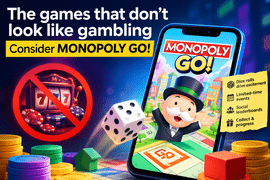
Consider MONOPOLY GO!
It is one of the clearest examples of how an apparently harmless mobile game can become a remarkably sophisticated engagement machine.
The game takes the familiar Monopoly formula and wraps it in dice rolls, events, collections, social interaction, limited-time challenges and an enormous virtual economy.
Its success is difficult to overstate.
Sensor Tower estimates that MONOPOLY GO! passed $6 billion in lifetime in-app purchase revenue during 2025, making it the fastest mobile game ever to reach that milestone.
Appfigures reported that it was the world’s highest-earning mobile game in January 2026, generating an estimated $134 million in net revenue that month.
The dice roll is the important part.
You don’t know exactly what will happen.
You tap.
The dice move.
You wait.
And then you discover whether the roll gives you what you wanted.
That tiny period between action and outcome is psychologically valuable.
Scopely has previously described deliberately designing MONOPOLY GO!’s dice mechanic around maintaining a player’s “flow state” — the immersive condition in which someone becomes deeply absorbed in an activity.
The company said the dice system took more than a year to develop.
That is not an accident.
The game is engineered around anticipation.
And anticipation can be more powerful than the reward itself.
Gossip Harbor and Township
Gossip Harbor and Township look much less like gambling.
They are casual, colourful games built around stories, building, farming, collecting and progression.
But modern free-to-play games increasingly share the same underlying architecture:
- timed rewards
- virtual currencies
- surprise prizes
- limited-time events
- upgrade systems
- daily missions
- collections
- increasingly difficult progression
None of those mechanics is automatically harmful.
Together, however, they create a system in which there is almost always a reason to return.
Research and regulatory reviews have increasingly focused on this wider ecosystem of loot boxes and chance-based rewards. The UK government’s review of loot boxes noted that more than half of the top 100 grossing mobile games in both Apple’s and Google’s app stores contained loot boxes.
The significance isn’t that every loot box is a gambling machine.
It is that uncertainty itself has become a monetisation strategy.
Roblox, Fortnite and Minecraft: the endless-game problem
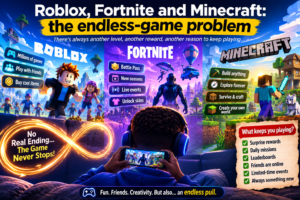
Then there are the giants.
Roblox. Fortnite. Minecraft.
These aren’t simply games anymore. They are digital environments where people spend enormous amounts of time creating, competing, socialising and exploring.
Roblox
Roblox is particularly interesting because it is essentially a platform containing millions of user-created experiences.
One game can be completely different from the next.
That variety is its superpower.
But it also means the player has no obvious reason to stop.
There is always another experience.
Another server.
Another reward.
Another thing to buy with Robux.
And some Roblox experiences have been criticised for using chance-based mechanics and loot-box-style systems that resemble gambling. Recent reporting has intensified scrutiny of these mechanics, particularly because of Roblox’s enormous young-user population.
The hardest part to put down?
There is no real ending.
Fortnite
Fortnite transformed from a battle-royale game into something closer to a digital entertainment platform.
Players compete, socialise, attend events, collect cosmetics and progress through seasonal systems.
The battle pass is particularly effective because it creates a countdown.
You have paid for the season.
You have rewards waiting.
The season ends soon.
Every unfinished reward suddenly feels like something you are losing.
The mechanic turns time into a resource.
Minecraft
Minecraft takes a different approach.
There is no conventional final boss waiting at the end of the experience.
You build.
Explore.
Mine.
Farm.
Automate.
Create.
Then you decide what to do next.
Its strength is also its retention mechanism:
there is always something else to build.
You can start playing at 8 p.m. and suddenly discover that it is midnight because there was never a natural stopping point.
That is one of the defining characteristics of modern digital games.
The game doesn’t have to tell you to continue.
It simply doesn’t give you a particularly good reason to stop.
Why mobile games are so difficult to put down
The psychology becomes easier to understand once you stop thinking about rewards and start thinking about anticipation.
Your brain doesn’t only react when something good happens.
It also reacts when you think something good might happen.
That distinction powers much of modern game design.
1. Variable rewards
If a game gave you exactly the same reward every time, you’d eventually stop caring.
But imagine opening a digital box where you might receive something ordinary, something rare or something extremely valuable.
Now every opening has suspense.
You don’t know what is coming.
That uncertainty makes the next attempt more interesting.
It is one reason loot boxes have attracted comparisons to gambling mechanics.
2. Near misses
Imagine trying to collect three rare items.
You receive two.
The third one is something almost useful.
You didn’t win.
But you didn’t feel completely defeated either.
That “almost” matters.
Near misses can create the psychological impression that success is close enough to justify another attempt.
3. Daily streaks
“Come back tomorrow.”
“Don’t break your streak.”
It sounds innocent.
But streaks turn absence into loss.
You aren’t just choosing whether to play tomorrow.
You’re choosing whether to destroy the progress you’ve accumulated.
4. Leaderboards
A leaderboard changes the psychological game completely.
You are no longer competing against the software.
You’re competing against another person.
Someone has just passed you.
Someone is 300 points ahead.
Someone has a better ranking.
Now the game has created a social reason to continue.
5. Battle passes
Battle passes introduce another powerful idea:
unfinished investment.
You have already spent money.
You have already reached Level 37.
There are still rewards at Levels 40, 45 and 50.
The season ends Friday.
Stopping can suddenly feel like wasting what you’ve already paid for.
6. No natural stopping point
Perhaps the most powerful mechanic is simply removing the ending.
Older games often had a finish line.
Modern live-service games have seasons.
Events.
Daily missions.
Weekly missions.
New characters.
New maps.
New skins.
New challenges.
New rewards.
There is no final screen.
There is only tomorrow’s content.
When entertainment starts affecting real life
None of this means that playing games causes mental illness.
That would be far too simplistic.
But research has repeatedly found associations between loot-box purchasing and gambling-related problems.
A study involving adolescents and young adults in Australia found that loot-box purchasing was associated with gambling frequency and problem-gambling measures.
Other research has similarly reported relationships between loot-box purchasing and problem-gambling severity among adolescents and young adults.
The distinction matters:
association is not proof of causation.
A person who already has risky gambling behaviour may be more attracted to loot boxes. Loot boxes may also reinforce existing tendencies. Both can be true.
The sensible response is neither panic nor dismissal.
It is attention.
What gaming problems can look like in teenagers
For teenagers, the consequences may appear in everyday behaviour before they appear in a bank statement.
Homework gets delayed.
Sleep gets sacrificed.
A parent asks for the phone.
The teenager becomes unusually angry.
A game session repeatedly stretches beyond the agreed limit.
Then there is money.
Digital currencies can make spending feel less real.
A child doesn’t necessarily experience 5,000 virtual coins as equivalent to $5 leaving a parent’s bank account.
That psychological distance can make accidental or impulsive purchases easier.
And when reward systems are combined with social pressure, limited-time events and competitive rankings, the pressure to keep participating can increase.
Adults have a different problem
Adults often have more control over their money and schedules.
That doesn’t necessarily make them immune.
The pattern can simply look different.
A notification arrives during work.
You check.
A new event has started.
You check again.
A reward expires tonight.
You play longer.
A purchase offers an advantage.
You spend.
Sleep gets pushed back.
Then tomorrow starts.
The problem isn’t always hours of continuous gaming.
Sometimes it is constant mental availability.
The game is always there.
The reward is always almost available.
And the phone is always within reach.
Why regulators are paying attention
The legal response is becoming more serious around the world.
Australia has tightened age-classification rules around games containing gambling-like mechanics and loot boxes, while research has continued to find such mechanics in games accessible to younger players.
In the United States, lawmakers and educators are also increasingly examining how digital games teach children about chance, virtual currencies and gambling-like systems.
Illinois, for example, has legislation requiring gaming-disorder education for students in grades 5–12, including discussion of risks associated with mechanics such as loot boxes and social-casino games.
The wider 2026 legal environment is even bigger.
More than 1,200 U.S. school districts have been involved in litigation alleging harms associated with social-media platforms, while a separate collection of cases and complaints has targeted gaming companies and game mechanics.
Those cases should not be casually lumped together.
But they point toward the same uncomfortable question:
Should technology companies be responsible not only for what their products contain, but also for how deliberately those products are engineered to hold our attention?
That question is no longer theoretical.
The games aren’t the enemy
There is a danger in this conversation.
We can become so focused on the risks that we forget why people play in the first place.
Games can be brilliant.
They can teach problem-solving.
They can encourage creativity.
They can develop strategy and memory.
They can connect people who live thousands of kilometres apart.
For some people, gaming is simply a relaxing way to spend twenty minutes after a difficult day.
Competition can be healthy.
Progression can be satisfying.
A reward system can make an otherwise ordinary activity genuinely enjoyable.
The issue isn’t whether games should be fun.
Of course they should.
The more interesting question is where entertainment ends and behavioural engineering begins.
There is a difference between:
“We made a great game, so people want to keep playing.”
and:
“We studied exactly what makes people return, spend and struggle to stop — and built the economy around those behaviours.”
The difference isn’t always visible on the screen.
But once you understand variable rewards, near misses, streaks, social pressure, battle passes and endless progression, you start seeing the machinery underneath the colourful graphics.
And perhaps that is the most useful thing a player can have:
not fear of games,
not blind trust in them,
but awareness.
Because the next time a game tells you that your reward is almost ready, your streak is about to disappear, your friends have passed you, or one more purchase will finally complete the collection, you can ask a very simple question:
Do I actually want to keep playing — or has the game simply become very good at making me feel that I should?
50 Loan Apps Changing How the World Borrows Money
50 Loan Apps Changing How the World Borrows Money Getting...
Read More
Why Nigerians Are Quietly Holding Dollars in Stablecoins Instead of Naira
Why Nigerians Are Quietly Holding Dollars in Stablecoins Instead of...
Read MoreThe Biggest AI Problem in Africa May Not Be AI
The Biggest AI Problem in Africa May Not Be AI...
Read More