
What Mobile Games Are Trending Among Nigerian Youths in 2026...
Read MoreImagine trying to find one useful molecule among millions of possibilities.
That is one of the enormous challenges scientists face when developing new medicines.
Traditionally, discovering and developing a drug can take many years and billions of dollars. Scientists have to identify promising molecules, test them, study their safety, and eventually put successful candidates through human clinical trials.
Now, artificial intelligence is changing one of the earliest and most difficult parts of that journey.
What Is Drug Discovery?
Before a medicine reaches a pharmacy, scientists need to discover a compound that could potentially treat a disease.
They might ask:
- Can this molecule interact with a disease-related protein?
- Could it stop a virus from multiplying?
- Could it block a process that causes cancer?
- Is it likely to be safe?
There can be millions of possible compounds to investigate.
Scientists cannot physically test all of them. This is where AI becomes useful.
AI Becomes a Molecular Detective

AI can analyse enormous amounts of biological and chemical data and identify patterns that would be difficult for humans to spot manually.
Researchers can train AI models using information about:
- molecules and their structures
- proteins
- diseases
- previous drug experiments
- genetic information
- biological interactions
The system can then help predict which molecules are worth investigating.
Instead of asking scientists to search through an enormous haystack, AI can help them identify where the most promising needles might be. But there is an important distinction:
AI makes predictions. Scientists still have to prove whether those predictions are correct.
From Millions of Possibilities to a Few Candidates
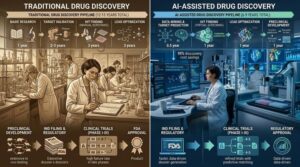
A simplified AI-assisted drug discovery process looks something like this:
Disease → Biological target → AI analysis → Candidate molecules → Laboratory testing → Clinical trials → Approval
AI can help at several points along this journey. It can help researchers identify biological targets, predict how molecules might interact with proteins, design or modify potential drug candidates, and prioritise which compounds should be tested first. This can save researchers enormous amounts of time and laboratory resources.
Protein Folding Changed the Game
One of the biggest breakthroughs in this area came from understanding proteins.
Proteins perform many important jobs inside living organisms. Their three-dimensional shapes influence how they work and how potential medicines interact with them.
Predicting these structures has historically been extremely difficult.
AI systems such as AlphaFold demonstrated how machine learning could predict protein structures at remarkable scale. This has given researchers another powerful source of information when investigating diseases and potential treatments.
The significance is bigger than simply “AI can predict proteins.”
It means researchers can increasingly combine biology, chemistry and computation when searching for new medicines.
AI Is Already Being Used in Drug Research
AI drug discovery is no longer just a futuristic idea.
Pharmaceutical companies, biotechnology companies and academic researchers are using machine learning and other computational methods to support research into areas such as:
Cancer
AI can help researchers analyse tumour biology, identify potential drug targets and investigate combinations of treatments.
Antibiotic Resistance
Drug-resistant bacteria are becoming a serious global health challenge. AI can help researchers search for molecules with antibacterial properties, including candidates that may have been difficult to identify using traditional approaches.
Rare Diseases
Some rare diseases have relatively small patient populations, making research difficult and expensive.
AI could help researchers analyse existing biological data and identify potential treatment opportunities more efficiently.
Neurological Diseases
Researchers are using AI to study complex biological systems involved in diseases such as Alzheimer’s and Parkinson’s.
The important point is that AI does not magically cure these diseases.
It helps researchers search, analyse and prioritise.
What AI Cannot Do

This is where some AI headlines become misleading.
AI does not simply create a medicine and send it to a pharmacy.
A promising computer prediction still has to survive reality.
Scientists need to determine whether a candidate actually works, whether it is toxic, how it behaves in the body, what dose is appropriate, and whether it is safe for humans.
Eventually, potential medicines must go through carefully controlled clinical trials and regulatory review.
So the future isn’t really:
AI replaces scientists.
It is closer to:
AI + scientists + laboratories + clinical research.
AI may handle enormous amounts of computation while humans provide scientific judgement, experimentation, safety oversight and accountability.
The Problem With “AI Makes Drugs in Days”
You may see headlines claiming that AI can discover a drug in days or months.
Be careful with those claims.
AI can dramatically accelerate parts of the discovery process, particularly computational screening, prediction and molecule design.
But developing an approved medicine is much bigger than finding a promising molecule.
The candidate still has to be tested.
And testing takes time.
This distinction will become increasingly important between 2026 and 2030, as more AI-designed or AI-assisted drug candidates move through clinical development.
The real opportunity is not necessarily turning a decade-long process into a few days.
It is making the search for promising candidates faster, more targeted and potentially less expensive.
The Next Few Years Could Be Very Interesting

Between 2026 and 2030, expect AI to become more deeply integrated into pharmaceutical research.
We are likely to see:
- More AI-designed or AI-assisted drug candidates entering clinical trials
- Better models for predicting molecular interactions
- Greater use of AI in personalised medicine
- More integration of genomic, biological and clinical data
- AI-assisted research into rare and neglected diseases
- Increasing use of automated laboratory systems alongside AI
The biggest shift may be the combination of AI software with automated laboratories.
Instead of AI simply making a prediction, future systems can increasingly follow a cycle:
Predict → Experiment → Measure → Learn → Predict again
That creates a much faster research loop.
But There Are Serious Questions
More powerful technology also creates difficult questions.
Who owns medicines created with AI?
Will AI-designed treatments be affordable?
Are the datasets used to train these systems representative of different populations?
Could biased or incomplete data produce unreliable predictions?
And if an AI system contributes to a failed treatment, who is responsible?
These questions matter because developing medicine isn’t only a technical challenge.
It is also a human, ethical and economic challenge.
What Does This Mean for Students?
Here’s perhaps the most exciting part.
You don’t have to choose between technology and biology.
The future of medicine will need people who understand both.
Students interested in this field could explore:
- Python and data science
- Artificial intelligence and machine learning
- Biology and genetics
- Chemistry
- Biomedical engineering
- Computational biology
- Bioinformatics
- AI ethics
You don’t need to become a drug researcher tomorrow.
Start by learning how computers work, how biological systems work, and how the two can work together.
The Bigger Picture
AI won’t eliminate the need for scientists.
It could make scientists much more capable.
A researcher who once had to spend enormous amounts of time searching through data can increasingly use AI to narrow the possibilities and focus attention on the experiments most worth performing.
That doesn’t mean every AI prediction will be correct.
It means researchers can potentially fail faster, learn faster and find promising ideas sooner.
And when you’re dealing with diseases that affect millions of people, that matters.
The Future of Medicine Is Becoming Computational
The next generation of medicines will not be created by doctors or computers alone.
They will come from a combination of biology, chemistry, computing, engineering and human judgement.
AI is becoming one of the tools researchers use to navigate that complexity.
The question for the next decade isn’t simply whether AI will change medicine.
It already has.
The more interesting question is:
What will scientists discover when AI helps them search where humans couldn’t search before?





50 Loan Apps Changing How the World Borrows Money
50 Loan Apps Changing How the World Borrows Money Getting...
Read More
Why Nigerians Are Quietly Holding Dollars in Stablecoins Instead of Naira
Why Nigerians Are Quietly Holding Dollars in Stablecoins Instead of...
Read More