Mobile Games Are Taking Over

At 11:47 p.m., someone who promised themselves they would play for ten minutes is still staring at their phone.

One more round.

One more reward.

One more roll.

One more attempt to overtake the person above them on the leaderboard.

The phone is small. The industry behind it is enormous.

Mobile gaming has evolved from simple time-killers into one of the world’s most sophisticated entertainment businesses. And some of the mechanics driving that growth have far more in common with casinos, behavioural psychology and social media than the old-fashioned video games many of us grew up with.

The interesting part is that most of these games don’t look dangerous.

Some look like solitaire.

Some look like Monopoly.

Some look like colourful farming games.

Some are played by children.

Others can actually pay you money.

And increasingly, the question isn’t simply whether these games are fun.

It’s whether they have become too good at keeping us playing.

The mobile gaming boom has changed shape

Mobile gaming is no longer just about downloading a game and playing it when you’re bored.

A new category has exploded around cash-prize competitions, sweepstakes and skill-based gaming.

Apps such as Solitaire Cash, 21 Blitz, Blackout Bingo, Bingo Cash, 8 Ball Strike and Bubble Cash take familiar formats — solitaire, bingo, pool and card games — and turn them into competitive tournaments.

The basic formula is remarkably simple.

Pay an entry fee. Play against other people. Climb the leaderboard. Win money.

Depending on the game and jurisdiction, withdrawals may be available through services such as PayPal, Venmo or Apple Pay.

That model is commercially powerful because it gives players something traditional mobile games cannot:

a reason to care immediately.

You’re not simply trying to beat a level.

There may be money on the line.

That has helped create a fast-growing lane of mobile entertainment that deliberately sits near the boundary between gaming, sweepstakes and gambling.

The legal classification varies by jurisdiction and by how a particular product operates. But commercially, the attraction is obvious: familiar games become much more exciting when every match feels like it matters.

And the same psychological principle appears in games where no real money changes hands.

The games that don’t look like gambling

The games that don't look like gambling
Consider MONOPOLY GO!"

Consider MONOPOLY GO!

It is one of the clearest examples of how an apparently harmless mobile game can become a remarkably sophisticated engagement machine.

The game takes the familiar Monopoly formula and wraps it in dice rolls, events, collections, social interaction, limited-time challenges and an enormous virtual economy.

Its success is difficult to overstate.

Sensor Tower estimates that MONOPOLY GO! passed $6 billion in lifetime in-app purchase revenue during 2025, making it the fastest mobile game ever to reach that milestone.

Appfigures reported that it was the world’s highest-earning mobile game in January 2026, generating an estimated $134 million in net revenue that month.

The dice roll is the important part.

You don’t know exactly what will happen.

You tap.

The dice move.

You wait.

And then you discover whether the roll gives you what you wanted.

That tiny period between action and outcome is psychologically valuable.

Scopely has previously described deliberately designing MONOPOLY GO!’s dice mechanic around maintaining a player’s “flow state” — the immersive condition in which someone becomes deeply absorbed in an activity.

The company said the dice system took more than a year to develop.

That is not an accident.

The game is engineered around anticipation.

And anticipation can be more powerful than the reward itself.

Gossip Harbor and Township

Gossip Harbor and Township look much less like gambling.

They are casual, colourful games built around stories, building, farming, collecting and progression.

But modern free-to-play games increasingly share the same underlying architecture:

  • timed rewards
  • virtual currencies
  • surprise prizes
  • limited-time events
  • upgrade systems
  • daily missions
  • collections
  • increasingly difficult progression

None of those mechanics is automatically harmful.

Together, however, they create a system in which there is almost always a reason to return.

Research and regulatory reviews have increasingly focused on this wider ecosystem of loot boxes and chance-based rewards. The UK government’s review of loot boxes noted that more than half of the top 100 grossing mobile games in both Apple’s and Google’s app stores contained loot boxes.

The significance isn’t that every loot box is a gambling machine.

It is that uncertainty itself has become a monetisation strategy.

Roblox, Fortnite and Minecraft: the endless-game problem

Roblox, Fortnite and Minecraft: the endless-game problem

Then there are the giants.

Roblox. Fortnite. Minecraft.

These aren’t simply games anymore. They are digital environments where people spend enormous amounts of time creating, competing, socialising and exploring.

Roblox

Roblox is particularly interesting because it is essentially a platform containing millions of user-created experiences.

One game can be completely different from the next.

That variety is its superpower.

But it also means the player has no obvious reason to stop.

There is always another experience.

Another server.

Another reward.

Another thing to buy with Robux.

And some Roblox experiences have been criticised for using chance-based mechanics and loot-box-style systems that resemble gambling. Recent reporting has intensified scrutiny of these mechanics, particularly because of Roblox’s enormous young-user population.

The hardest part to put down?

There is no real ending.

Fortnite

Fortnite transformed from a battle-royale game into something closer to a digital entertainment platform.

Players compete, socialise, attend events, collect cosmetics and progress through seasonal systems.

The battle pass is particularly effective because it creates a countdown.

You have paid for the season.

You have rewards waiting.

The season ends soon.

Every unfinished reward suddenly feels like something you are losing.

The mechanic turns time into a resource.

Minecraft

Minecraft takes a different approach.

There is no conventional final boss waiting at the end of the experience.

You build.

Explore.

Mine.

Farm.

Automate.

Create.

Then you decide what to do next.

Its strength is also its retention mechanism:

there is always something else to build.

You can start playing at 8 p.m. and suddenly discover that it is midnight because there was never a natural stopping point.

That is one of the defining characteristics of modern digital games.

The game doesn’t have to tell you to continue.

It simply doesn’t give you a particularly good reason to stop.

Why mobile games are so difficult to put down

The psychology becomes easier to understand once you stop thinking about rewards and start thinking about anticipation.

Your brain doesn’t only react when something good happens.

It also reacts when you think something good might happen.

That distinction powers much of modern game design.

1. Variable rewards

If a game gave you exactly the same reward every time, you’d eventually stop caring.

But imagine opening a digital box where you might receive something ordinary, something rare or something extremely valuable.

Now every opening has suspense.

You don’t know what is coming.

That uncertainty makes the next attempt more interesting.

It is one reason loot boxes have attracted comparisons to gambling mechanics.

2. Near misses

Imagine trying to collect three rare items.

You receive two.

The third one is something almost useful.

You didn’t win.

But you didn’t feel completely defeated either.

That “almost” matters.

Near misses can create the psychological impression that success is close enough to justify another attempt.

3. Daily streaks

“Come back tomorrow.”

“Don’t break your streak.”

It sounds innocent.

But streaks turn absence into loss.

You aren’t just choosing whether to play tomorrow.

You’re choosing whether to destroy the progress you’ve accumulated.

4. Leaderboards

A leaderboard changes the psychological game completely.

You are no longer competing against the software.

You’re competing against another person.

Someone has just passed you.

Someone is 300 points ahead.

Someone has a better ranking.

Now the game has created a social reason to continue.

5. Battle passes

Battle passes introduce another powerful idea:

unfinished investment.

You have already spent money.

You have already reached Level 37.

There are still rewards at Levels 40, 45 and 50.

The season ends Friday.

Stopping can suddenly feel like wasting what you’ve already paid for.

6. No natural stopping point

Perhaps the most powerful mechanic is simply removing the ending.

Older games often had a finish line.

Modern live-service games have seasons.

Events.

Daily missions.

Weekly missions.

New characters.

New maps.

New skins.

New challenges.

New rewards.

There is no final screen.

There is only tomorrow’s content.

When entertainment starts affecting real life

None of this means that playing games causes mental illness.

That would be far too simplistic.

But research has repeatedly found associations between loot-box purchasing and gambling-related problems.

A study involving adolescents and young adults in Australia found that loot-box purchasing was associated with gambling frequency and problem-gambling measures.

Other research has similarly reported relationships between loot-box purchasing and problem-gambling severity among adolescents and young adults.

The distinction matters:

association is not proof of causation.

A person who already has risky gambling behaviour may be more attracted to loot boxes. Loot boxes may also reinforce existing tendencies. Both can be true.

The sensible response is neither panic nor dismissal.

It is attention.

What gaming problems can look like in teenagers

For teenagers, the consequences may appear in everyday behaviour before they appear in a bank statement.

Homework gets delayed.

Sleep gets sacrificed.

A parent asks for the phone.

The teenager becomes unusually angry.

A game session repeatedly stretches beyond the agreed limit.

Then there is money.

Digital currencies can make spending feel less real.

A child doesn’t necessarily experience 5,000 virtual coins as equivalent to $5 leaving a parent’s bank account.

That psychological distance can make accidental or impulsive purchases easier.

And when reward systems are combined with social pressure, limited-time events and competitive rankings, the pressure to keep participating can increase.

Adults have a different problem

Adults often have more control over their money and schedules.

That doesn’t necessarily make them immune.

The pattern can simply look different.

A notification arrives during work.

You check.

A new event has started.

You check again.

A reward expires tonight.

You play longer.

A purchase offers an advantage.

You spend.

Sleep gets pushed back.

Then tomorrow starts.

The problem isn’t always hours of continuous gaming.

Sometimes it is constant mental availability.

The game is always there.

The reward is always almost available.

And the phone is always within reach.

Why regulators are paying attention

The legal response is becoming more serious around the world.

Australia has tightened age-classification rules around games containing gambling-like mechanics and loot boxes, while research has continued to find such mechanics in games accessible to younger players.

In the United States, lawmakers and educators are also increasingly examining how digital games teach children about chance, virtual currencies and gambling-like systems.

Illinois, for example, has legislation requiring gaming-disorder education for students in grades 5–12, including discussion of risks associated with mechanics such as loot boxes and social-casino games.

The wider 2026 legal environment is even bigger.

More than 1,200 U.S. school districts have been involved in litigation alleging harms associated with social-media platforms, while a separate collection of cases and complaints has targeted gaming companies and game mechanics.

Those cases should not be casually lumped together.

But they point toward the same uncomfortable question:

Should technology companies be responsible not only for what their products contain, but also for how deliberately those products are engineered to hold our attention?

That question is no longer theoretical.

The games aren’t the enemy

There is a danger in this conversation.

We can become so focused on the risks that we forget why people play in the first place.

Games can be brilliant.

They can teach problem-solving.

They can encourage creativity.

They can develop strategy and memory.

They can connect people who live thousands of kilometres apart.

For some people, gaming is simply a relaxing way to spend twenty minutes after a difficult day.

Competition can be healthy.

Progression can be satisfying.

A reward system can make an otherwise ordinary activity genuinely enjoyable.

The issue isn’t whether games should be fun.

Of course they should.

The more interesting question is where entertainment ends and behavioural engineering begins.

There is a difference between:

“We made a great game, so people want to keep playing.”

and:

“We studied exactly what makes people return, spend and struggle to stop — and built the economy around those behaviours.”

The difference isn’t always visible on the screen.

But once you understand variable rewards, near misses, streaks, social pressure, battle passes and endless progression, you start seeing the machinery underneath the colourful graphics.

And perhaps that is the most useful thing a player can have:

not fear of games,

not blind trust in them,

but awareness.

Because the next time a game tells you that your reward is almost ready, your streak is about to disappear, your friends have passed you, or one more purchase will finally complete the collection, you can ask a very simple question:

Do I actually want to keep playing — or has the game simply become very good at making me feel that I should?

Other Links

50 Loan Apps Changing How the World Borrows Money

Getting a loan used to mean visiting a bank, filling out forms, finding a guarantor, providing collateral and waiting days or weeks.

Today, a smartphone can do most of that work in minutes.

From Nigeria and Kenya to India, the United States, Indonesia, Mexico and the Philippines, digital lending apps have changed the way millions of people access credit.

And the industry is getting bigger.

The global digital lending platform market was estimated at about $13.1 billion in 2025, with strong growth expected as more financial services move online. One major market study projects a roughly 29% annual growth rate through 2033. (Grand View Research)

But there is another side to the story.

A loan app can help someone buy stock for a small business, pay school fees, handle an emergency or bridge a short-term cash-flow problem.

The same loan can also become a debt trap if the borrower takes money without understanding the total cost.

So, here is a global look at 50 major digital lending and credit apps/platforms, where they are strong, what they generally charge and what borrowers should understand before clicking “Apply.”

Important: Loan pricing changes frequently and is often personalised according to credit score, country, loan size, repayment period and lender. The percentages below are therefore best treated as indicative pricing ranges or disclosed examples, not guaranteed offers. Some lenders publish APRs rather than monthly rates, while others charge daily fees, processing fees or one-time charges. Always check the final loan agreement before accepting.


Why Are Loan Apps Growing So Fast?

The biggest reason is simple:

People already have smartphones.

The World Bank’s Global Findex 2025 found that 86% of adults globally own a mobile phone, while about 79% of adults worldwide have a financial account. Digital payments and mobile financial services have also grown rapidly. (World Bank)

That creates a huge opportunity for digital lenders.

Traditional banks often ask for:

    • Salary history

    • Bank statements

    • Credit history

    • Collateral

    • Guarantors

    • Physical documents

    • Branch visits

A digital lender can potentially analyse transaction history, repayment behaviour, income patterns and other permitted data to make a credit decision much faster.

Some companies can approve a loan in minutes.

That speed is their biggest selling point.

It is also one of their biggest risks.


The 50 Loan Apps You Should Know

1. Branch

Major markets: Nigeria, Kenya, Tanzania and other emerging markets.

Market penetration: Very strong in Africa. Branch has surpassed 50 million Google Play downloads in Nigeria alone, according to June 2026 app-store data reported by Nairametrics. (Nairametrics)

Typical cost: Pricing varies by market and borrower. Nigeria pricing can vary considerably according to loan size and repayment period.

Why it matters: Branch is a classic example of how alternative data and mobile technology can replace some traditional credit-screening methods.

Its model focuses heavily on people who may not have a traditional bank credit history.


2. Tala

Major markets: Kenya, Mexico, Philippines and India.

Market penetration: More than 6 million people have accessed credit through Tala, while its global platform says it has served around 14 million customers and processed billions of dollars in lending performance data. (Tala Kenya)

Typical cost: In Kenya, disclosed credit-line interest can range from 0.3%–0.6% per day, equivalent to roughly 9%–18% per 30 days before considering compounding and other charges. Tala’s Kenya terms disclose APRs of 109.5%–219%. (Tala Kenya)

In the Philippines, Tala discloses a 0.23%–0.43% daily service fee, plus processing fees. (Google Play)

Important lesson: A small daily percentage can become a very large annual cost.


3. FairMoney

Major markets: Nigeria, with roots and expansion across emerging markets.

Market penetration: One of Nigeria’s largest digital lenders. Its app has 10M+ Google Play downloads and the company says it has more than 5 million users. (Google Play)

Typical cost: Nigerian pricing varies substantially by customer and product. Recent market reporting puts some offers around 2.5%–30% monthly, depending on the loan. (Nairametrics)

Why it makes money: FairMoney has moved beyond simply giving loans. Its ecosystem includes banking, savings, payments and other financial services.

That is an important trend in fintech:

The winning companies are becoming financial platforms, not just loan apps.


4. Palmcredit

Major market: Nigeria.

Market penetration: 10M+ Google Play downloads. (Google Play)

Typical cost: Palmcredit currently advertises an APR range of 24%–36% in its Google Play listing, with an example of 3% per month on a six-month loan. (Google Play)

Best known for: Quick personal credit without traditional collateral.


5. Carbon

Major market: Nigeria.

Market penetration: 5M+ Google Play downloads as of June 2026. (Nairametrics)

Typical cost: Varies by product and customer.

Why it is interesting: Carbon has evolved from a lending company into a broader digital financial platform offering banking, payments, savings, investments and credit.


6. OKash

Major markets: Nigeria and other emerging markets.

Market penetration: 10M+ downloads reported in Nigerian Google Play rankings. (Inventrium — IBSS)

Typical cost: Varies according to borrower and loan duration.

Business model: Small, fast loans + large numbers of borrowers + automated credit scoring.


7. Renmoney

Major market: Nigeria.

Market penetration: Established Nigerian digital lender and microfinance bank.

Typical cost: Varies by loan product, amount and repayment period.

Strength: Longer-term consumer loans compared with some ultra-short-term lending apps.


8. EaseMoni

Major market: Nigeria.

Market penetration: 10M+ Google Play downloads reported in June 2026. (Business Elites Africa)

Typical cost: Varies according to customer and product.

Why it matters: It illustrates how mobile lending can reach borrowers who may have difficulty accessing traditional bank loans.


9. Migo

Major markets: Nigeria and other emerging markets.

Typical cost: Product and partner dependent.

Interesting feature: Migo has focused on embedding credit into digital commerce rather than relying only on a standalone lending app.

That idea is becoming increasingly important:

The future of lending may be invisible.

Instead of opening a loan app, you may simply choose “Pay later” while buying something.


10. Moniepoint

Major market: Nigeria.

Market penetration: One of Nigeria’s largest fintech platforms, particularly among small businesses.

Typical cost: Working-capital and business-credit pricing varies.

Why it matters: Moniepoint demonstrates how transaction data can become a source of credit information.

A trader receiving payments through a digital platform creates a financial record. That record can potentially help the platform assess the trader’s ability to repay.


India

India has become one of the world’s most important digital-finance markets because of smartphones, UPI, huge consumer demand and rapid digital payments.

11. KreditBee

Major market: India.

Typical cost: Interest and processing fees vary by borrower and product.

Market position: One of India’s best-known digital personal-loan platforms.


12. Navi

Major market: India.

Typical cost: Product-dependent.

Why it matters: Navi combines lending with other financial products and uses a highly digital customer experience.


13. Moneyview

Major market: India.

Market penetration: Its Google Play app has 10M+ downloads. It offers personal loans up to ₹10 lakh through its digital platform. (Google Play)

Typical cost: Varies by borrower.

Strength: It combines personal-finance management with access to credit.


14. Fibe

Major market: India.

Market penetration: More than 3.3 million Indians served and 10M+ Google Play downloads. (Google Play)

Typical cost: Varies.

Loan duration: Its listed personal-loan products can run from 6 to 36 months. (Google Play)


15. Stashfin

Major market: India.

Market penetration: 10M+ Google Play downloads; the company describes itself as having served tens of millions of users. (Google Play)

Typical cost: Depends on the credit product.

Products: Credit, payments, personal loans and other financial services.


16. CASHe

Major market: India.

Typical cost: Risk-based and product-specific.

Target: Salaried and young working professionals.


17. mPokket

Major market: India.

Target: Students and young adults.

Typical cost: Varies by borrower and product.

Important: Young borrowers should be especially careful because easy access to credit can encourage borrowing before they have stable income.


18. Kreditzy

Major market: India.

Typical cost: Varies by loan offer.

Business model: Short digital personal loans using online credit assessment.


19. Bajaj Finserv

Major market: India.

Market penetration: A major Indian financial-services company rather than a small standalone loan app.

Products: Personal loans, consumer finance, business finance and other financial products.

Typical cost: Product and customer dependent.


20. Freo

Major market: India.

Typical cost: Product-dependent.

Why it matters: Freo represents the movement toward financial apps that combine credit with broader personal-finance services.


Kenya and East Africa

East Africa is one of the most interesting digital lending markets in the world.

Why?

Because mobile money arrived before traditional banking became deeply established in many communities.

That created a natural environment for mobile credit.

21. M-Shwari

Major market: Kenya.

Provider: NCBA through the M-PESA ecosystem.

Loan range: KSh50 to KSh1 million across the M-PESA lending ecosystem, depending on product and eligibility. (Safaricom)

Cost: M-Shwari loans use a predetermined one-time access fee rather than a simple monthly interest rate. (Safaricom)

Why it matters: It demonstrates how lending can be built directly into a mobile-money ecosystem.


22. KCB M-PESA

Major market: Kenya.

Typical cost: Product-specific access/interest charges.

KCB reported strong growth in mobile lending, including an 8% year-on-year increase in disbursements following improvements to its credit-scoring model. (KCB Group)


23. Fuliza

Major market: Kenya.

Type: Mobile overdraft rather than a traditional personal loan.

Cost: Includes access and daily charges depending on the facility and lender terms.

Why it is powerful: It allows customers to complete M-PESA transactions even when their wallet balance is insufficient.

That is essentially credit built into a payment system.


24. Timiza

Major market: Kenya.

Provider: ABSA Kenya partnership.

Type: Digital wallet + loans + financial services.

Cost: Varies.


25. Fido

Major market: Ghana and other African markets.

Typical cost: Risk-based.

Target: Consumers and small businesses needing fast digital credit.


Indonesia

Indonesia has developed a huge digital-credit ecosystem around smartphones, e-commerce and digital payments.

26. Kredivo

Major markets: Indonesia and Southeast Asia.

Type: Personal credit + buy-now-pay-later.

Typical cost: Product-dependent.

Why it matters: Kredivo shows how lending and shopping can merge into one experience.


27. Akulaku

Major markets: Indonesia and Southeast Asia.

Products: Digital credit, instalments and financial services.

Typical cost: Varies.


28. JULO

Major market: Indonesia.

Market penetration: 10M+ Google Play downloads.

Typical loan: Up to Rp50 million according to its Google Play listing. (Google Play)

Typical cost: Varies by product and customer.


29. Indodana

Major market: Indonesia.

Type: Digital loans and pay-later financing.

Typical cost: Product-dependent.


30. Kredivo PayLater

Major market: Indonesia and Southeast Asia.

Type: Consumer credit/BNPL.

Why it matters: It allows consumers to convert purchases into instalment payments.

The important lesson is that not all digital debt arrives looking like a loan.

Sometimes it looks like a checkout button saying:

“Pay later.”


Philippines

31. Tala Philippines

Major market: Philippines.

Typical cost: Tala lists processing fees of 3.99%–9.99% and service fees of 0.23%–0.43% per day for its Philippine credit product. It also discloses a monthly effective interest rate of about 11%–12% for the product described in its listing. (Google Play)


32. BillEase

Major market: Philippines.

Type: Personal loans, instalment credit and BNPL.

Typical cost: Varies by product and borrower.


33. Cashalo

Major market: Philippines.

Type: Consumer and merchant credit.

Typical cost: Varies.

Why it matters: Cashalo has focused on bringing digital credit to consumers and merchants who may have limited access to traditional banking.


Mexico and Latin America

34. Kueski

Major market: Mexico.

Type: Personal loans and BNPL.

Typical cost: Can be high for short-term credit; exact pricing depends on the product.

Important: Mexico illustrates why consumers should compare CAT/APR, not just a monthly-looking interest number.


35. Tala Mexico

Major market: Mexico.

Cost: Tala’s Mexican listing currently shows annual interest rates ranging from 201% to 432% excluding VAT, with the effective cost potentially much higher depending on fees and term. (Google Play)

This is an excellent example of why a loan advertised as “easy money” can become expensive money.


36. Nu

Major markets: Brazil, Mexico and other Latin American markets.

Type: Digital banking + credit cards + personal credit.

Typical cost: Varies considerably by country and product.

Why it matters: Nubank demonstrates the scale possible when credit is integrated into a full digital bank.


37. Mercado Pago

Major markets: Latin America.

Type: Digital wallet + merchant finance + consumer credit.

Strength: Its enormous payments and e-commerce ecosystem gives it transaction data that can support credit decisions.


38. PicPay

Major market: Brazil.

Type: Digital wallet, credit and financial services.

Typical cost: Product-dependent.


United States

The US market is different.

It has mature credit bureaus, established banks and highly regulated consumer-credit products.

But fintech companies are still disrupting the market.

39. SoFi

Major market: United States.

Type: Personal loans, student refinancing, banking and investing.

Typical cost: Risk-based APR rather than a simple monthly percentage.

Strength: Targets consumers with stronger credit profiles and has built a broad financial-services ecosystem.


40. Upstart

Major market: United States.

Type: AI-assisted lending marketplace/platform.

Typical cost: Risk-based APR.

Why it matters: Upstart is one of the clearest examples of technology being used to change traditional credit underwriting.


41. LendingClub

Major market: United States.

Type: Personal loans and digital banking.

Typical cost: Risk-based APR.

Why it matters: LendingClub helped popularise the idea of technology-driven consumer lending at scale.


42. Upgrade

Major market: United States.

Type: Personal loans, credit cards and banking.

Typical cost: Risk-based APR.

Target: Consumers looking for credit and debt-management products.


43. Prosper

Major market: United States.

Type: Personal loans.

Typical cost: Risk-based APR.

Why it matters: Prosper is one of the major names associated with marketplace/peer-to-peer-style digital lending.


44. OneMain Financial

Major market: United States.

Type: Personal loans.

Typical cost: Varies significantly by credit profile.

Difference: Unlike many app-only fintechs, OneMain also has a physical branch network.


45. MoneyLion

Major market: United States.

Type: Financial app, credit products, cash advances and personal finance.

Typical cost: Depends on the product.

Business model: Financial products are bundled into a single consumer app.


46. Dave

Major market: United States.

Type: Cash advances and digital banking.

Typical cost: Product-dependent, including possible membership and express-transfer fees.

Important: A cash advance is not necessarily the same thing as a conventional instalment loan.


47. EarnIn

Major market: United States.

Type: Earned-wage access.

This is another important distinction.

Earned-wage access lets eligible workers access part of money they have already earned before payday.

That is different from borrowing against future income in the traditional sense.


United Kingdom and Europe

48. Zopa

Major market: United Kingdom.

Type: Personal loans, credit cards and digital banking.

Typical cost: Risk-based APR.

Why it matters: Zopa is one of the UK’s established fintech lending brands.


49. Revolut

Major markets: Europe and an expanding global footprint.

Type: Digital banking, cards, credit and other financial services.

Typical cost: Depends heavily on country and product.

Revolut is expanding beyond payments into lending and mortgages in some markets. In Australia, for example, the company has been exploring mortgage lending after receiving banking approval. (Reuters)


50. Monzo

Major market: United Kingdom.

Type: Digital banking, overdrafts, loans and other financial services.

Typical cost: Product and customer dependent.

Why it matters: Monzo shows another major trend: the loan is becoming one feature inside a much larger digital banking relationship.


The Big Pattern Behind All 50

Look closely at these companies and something becomes obvious.

The world’s biggest digital lenders are not all doing exactly the same thing.

But they share several characteristics.

1. They reduce friction

Traditional lending can be slow.

Digital lending can happen from a smartphone.

2. They use data

Many digital lenders use transaction history, repayment behaviour, account activity and other permitted information to assess borrowers.

3. They target underserved customers

Many customers do not have perfect credit histories.

Some have never borrowed from a bank.

Digital lenders can use alternative information to make decisions.

4. They make borrowing convenient

And convenience is valuable.

People will often pay for speed.

5. They build ecosystems

The most powerful companies are increasingly offering:

Payments → Banking → Savings → Credit → Investments → Insurance → Shopping

Once a company controls several parts of a customer’s financial life, it can generate revenue from many activities rather than depending only on loan interest.


So How Do Loan Apps Actually Make Money?

This is where the business becomes interesting.

A lender does not simply “give people money.”

It buys or raises capital, lends that capital to borrowers and earns money from the difference between its funding cost and what borrowers pay.

Its revenue can come from:

    • Interest

    • Processing fees

    • Origination fees

    • Late-payment fees

    • Subscription fees

    • Merchant fees

    • BNPL fees

    • Card fees

    • Insurance

    • Investment products

    • Banking services

    • Cross-selling

Imagine a lender has access to ₦1 billion in capital.

It might lend that money to thousands of customers.

If its average effective yield is significantly higher than its funding and operating costs, the spread can become its profit.

But there is a major problem:

Some borrowers will not repay.

That is called credit risk.

So the lender must price loans high enough to cover:

Funding cost + technology + employees + marketing + fraud + defaults + regulatory costs + collections + profit.

That is one reason some short-term digital loans can be expensive.


Why Are Investors Interested in Digital Lending?

Because lending can produce recurring revenue.

If a borrower takes one loan and successfully repays it, the lender has learned something.

The borrower now has a repayment history.

The lender can potentially offer another loan.

This creates a cycle:

Borrow → Repay → Build data → Receive larger limit → Borrow again

Tala, for example, says its credit platform uses years of repayment data and more than $8 billion in lending-performance data across 14 million customers. (Tala)

That data can become a competitive advantage.

The company understands its customers better with every lending cycle.


But Here Is the Dangerous Part

Easy money can become expensive money.

The biggest mistake borrowers make is looking only at the amount they will receive.

Someone says:

“I can get ₦200,000 today.”

The better question is:

“How much will I repay in total?”

Those are two completely different questions.


Why “2% a Month” Can Be Misleading

Suppose someone borrows ₦100,000.

A lender says:

Interest = 2% monthly.

That sounds cheap.

But what if there is:

    • 5% processing fee

    • Insurance fee

    • Transfer fee

    • Late fee

    • Daily penalty

    • Compulsory subscription

Suddenly, the headline interest rate does not tell the whole story.

This is why borrowers should compare the total cost of credit, not just the advertised interest rate.


The Biggest Danger: Debt Traps

A debt trap happens when you borrow money to repay another loan.

For example:

Loan A → cannot repay → Loan B → cannot repay → Loan C → Loan D

Now your income is being used to service old debt rather than create new value.

This can become extremely dangerous.

US consumer-protection research has repeatedly documented how repeated borrowing and rollovers can turn short-term high-cost loans into long-term debt problems. (Consumer Financial Protection Bureau)

The lesson applies globally:

A loan that solves today’s problem but creates next month’s problem is not a real solution.


Good Reasons to Borrow

A loan can make sense when it is used for:

Business inventory

You buy stock that you can sell at a profit.

Equipment

You purchase equipment that increases your ability to earn.

Education

A loan may be reasonable if the education significantly improves your earning potential and the repayment is realistic.

Emergency expenses

Sometimes borrowing is necessary to handle an urgent problem.

Working capital

A business may borrow to bridge a temporary gap between spending money and receiving customer payments.


Dangerous Reasons to Borrow

Be very careful when borrowing for:

    • Gambling

    • Luxury purchases

    • Unnecessary parties

    • Lifestyle pressure

    • Paying another loan

    • Speculation

    • Investments you do not understand

    • Cryptocurrency speculation

    • “Guaranteed” investment schemes

    • Buying things simply because you can borrow the money

The question should always be:

What will this money produce?

If the answer is “nothing”, you are probably consuming the loan rather than using it productively.


The Investment Trap

This deserves special attention.

You may hear:

“Borrow money and invest it. The investment will pay the loan.”

This can work in theory.

But it is dangerous.

Suppose:

    • Loan cost = 20% per year

    • Investment expected return = 25%

That does not automatically mean you should borrow.

Why?

Because the investment return is uncertain.

The loan cost is not.

You must repay the lender whether your investment makes 25%, 5%, 0% or loses 30%.

This creates leverage.

Leverage means using borrowed money to increase the size of an investment.

It can increase profits.

It can also increase losses.


What About Personal Data?

This is another major issue with digital lending.

When you apply for credit, you may provide:

    • Name

    • Phone number

    • Identification

    • Bank details

    • Income information

    • Transaction information

    • Credit history

    • Device information

Depending on the lender and jurisdiction, other data may also be collected.

Consumers should understand:

Who is collecting my information?

Why do they need it?

How long will they keep it?

Who can they share it with?

The US Consumer Financial Protection Bureau warns that online loan applications can expose consumers to privacy risks and notes that some sites are actually lead generators that collect applicants’ information and pass it to lenders or other businesses. (Consumer Financial Protection Bureau)


Watch Out for Loan Scams

One of the clearest warning signs is:

“Pay us first and we will guarantee your loan.”

Be extremely careful.

The US Federal Trade Commission warns about advance-fee loan scams in which fraudsters promise credit but demand money upfront for “processing”, “insurance” or other fake reasons. (Consumer Advice)

A legitimate lender should provide clear terms.

You should know:

    • Who the lender is

    • Where it is licensed

    • How much you will receive

    • How much you will repay

    • When you must repay

    • What happens if you are late

    • What fees apply

    • How your information is handled


The Future of Lending Is Bigger Than Loan Apps

The next generation of lending will probably not look like today’s loan apps.

Credit is moving into:

E-commerce

Digital wallets

Banking apps

Payroll platforms

Business software

POS systems

Mobile-money platforms

Marketplaces

Super apps

Imagine running a small shop.

Your payment platform already knows:

    • How much you sell

    • When you sell

    • Your busiest days

    • Your average transaction size

    • Your cash flow

    • Your repayment history

The platform could eventually say:

“Based on your business activity, you qualify for ₦500,000 working capital.”

No bank branch.

No long application.

No traditional paperwork.

That is where digital lending becomes extremely powerful.


Why Africa Could Become One of the Most Important Lending Markets

Africa has a huge population of young people, rapidly growing smartphone use and enormous demand for financial services.

The World Bank says nearly 80% of adults globally now have a financial account, but 1.3 billion adults still remain without access to financial accounts. It also reports that 86% of adults globally own mobile phones. (World Bank)

This creates a huge opportunity.

Africa does not necessarily need to copy the old banking system.

A smartphone can become:

Bank + wallet + credit history + payment terminal + investment account + business tool.

That is a major shift.


But More Credit Does Not Automatically Mean More Wealth

This is probably the most important point in the entire article.

Access to money is not the same as access to wealth.

A person can have access to ten loan apps and still be financially poor.

Why?

Because borrowed money must eventually be repaid.

Real financial progress happens when borrowed money is converted into something that produces more value.

For example:

₦500,000 loan → inventory → ₦700,000 sales → repay loan → keep profit

is very different from:

₦500,000 loan → lifestyle spending → nothing left → borrow again

The first can create wealth.

The second can create a debt cycle.


Before You Take Your Next Digital Loan, Use This Checklist

Ask these questions:

    1. Who owns the lending company?

    1. Is it legally licensed in my country?

    1. How much money will actually enter my account?

    1. What is the total amount I must repay?

    1. What is the APR/EIR?

    1. Are there processing fees?

    1. Are there late fees?

    1. What happens if I miss a payment?

    1. Can the lender automatically debit my account?

    1. What personal data does the app collect?

    1. Can I comfortably repay it from my normal income?

    1. What happens if my income drops?

    1. What exactly will I use the money for?

    1. Will the borrowed money produce more value than it costs?

    1. Am I borrowing to repay another loan?

If you cannot answer these questions, do not press the “Accept” button yet.


Final Verdict: Loan Apps Are Neither Good Nor Bad

They are tools.

And like most financial tools, the outcome depends on how they are used.

A good digital lender can give someone access to capital that a traditional bank would never provide.

A good loan can help a business grow.

It can help someone handle an emergency.

It can help someone buy productive equipment.

It can create an opportunity.

But an expensive loan taken without a repayment plan can destroy cash flow, damage credit and create a cycle of borrowing.

The most financially intelligent borrower is not the person who can borrow the most.

It is the person who understands when to borrow, how much to borrow, what the money will produce and exactly what the money will cost.

And perhaps the biggest lesson from the global rise of digital lending is this:

The world is making borrowing easier. That makes understanding money more important than ever.


The 50 Apps at a Glance

# Platform Strong markets Typical pricing approach
1 Branch Africa, emerging markets Risk-based
2 Tala Kenya, Mexico, Philippines, India Daily/annual rates
3 FairMoney Nigeria Risk-based/monthly
4 Palmcredit Nigeria ~3%/month example
5 Carbon Nigeria Product-dependent
6 OKash Nigeria Product-dependent
7 Renmoney Nigeria Product-dependent
8 EaseMoni Nigeria Product-dependent
9 Migo Nigeria/emerging markets Product-dependent
10 Moniepoint Nigeria Business/product dependent
11 KreditBee India Risk-based
12 Navi India Product-dependent
13 Moneyview India Risk-based
14 Fibe India Risk-based
15 Stashfin India Product-dependent
16 CASHe India Risk-based
17 mPokket India Product-dependent
18 Kreditzy India Risk-based
19 Bajaj Finserv India Product-dependent
20 Freo India Product-dependent
21 M-Shwari Kenya Access/loan fees
22 KCB M-PESA Kenya Product-dependent
23 Fuliza Kenya Access/daily charges
24 Timiza Kenya Product-dependent
25 Fido Ghana/Africa Risk-based
26 Kredivo Indonesia/SEA Credit/BNPL
27 Akulaku SEA Product-dependent
28 JULO Indonesia Product-dependent
29 Indodana Indonesia Product-dependent
30 Kredivo PayLater SEA Instalment/BNPL
31 Tala Philippines Philippines 0.23–0.43% daily + fees
32 BillEase Philippines Product-dependent
33 Cashalo Philippines Product-dependent
34 Kueski Mexico Product-dependent
35 Tala Mexico Mexico Very high APR possible
36 Nubank Brazil/LatAm Product-dependent
37 Mercado Pago Latin America Product-dependent
38 PicPay Brazil Product-dependent
39 SoFi US APR/risk-based
40 Upstart US APR/risk-based
41 LendingClub US APR/risk-based
42 Upgrade US APR/risk-based
43 Prosper US APR/risk-based
44 OneMain Financial US APR/risk-based
45 MoneyLion US Product-dependent
46 Dave US Fees/subscription/product
47 EarnIn US Cash-advance model
48 Zopa UK APR/risk-based
49 Revolut Europe/global Country/product dependent
50 Monzo UK Product-dependent

A note about the table

There is no single reliable global database that ranks “the top 50 loan apps” by market share. Loan companies report users, downloads, loan originations and revenue differently, while many operate through banks or embedded-finance partnerships rather than a standalone loan app.

For that reason, this list combines global footprint, consumer reach, app adoption, market importance and relevance to digital lending, rather than pretending there is a precise global #1–#50 market-share ranking.

For example, Branch’s 50M+ Nigerian downloads, Tala’s millions of global customers, FairMoney’s 10M+ Nigerian Google Play downloads and Fibe’s 3.3M+ Indian customers are measurable indicators of reach, but they are not directly comparable measures of market share. (Inventrium — IBSS)


Why Nigerians Are Quietly Holding Dollars in Stablecoins Instead of Naira

Walk through a Lagos market or scroll a Nigerian Telegram group and you’ll notice something understated: more people price big purchases, hold savings, or settle invoices in USDT or USDC than they admit out loud. It’s not a loud crypto gold rush. It’s a practical, almost silent migration to digital dollars.

The Naira’s credibility problem

Since the 2023 float, the naira has lost the bulk of its value—moving from roughly ₦460 per dollar to peaks above ₦1,600 before settling in the mid-to-high 1,300s. Inflation has run hot for years (peaking well above 30% and still elevated). Official foreign-exchange access has often been tight or expensive. Physical dollars exist, but they come with spreads, counterparty risk, and the friction of meeting someone who has cash. Bank domiciliary accounts help some, yet many face limits, delays, or conversion headaches.

In that environment, holding pure naira is a slow leak. Salaries shrink in real terms. Businesses that import inputs watch margins vanish. Savers see purchasing power erode faster than interest can compensate.

Why stablecoins became the workaround

Stablecoins—primarily USDT (Tether) and increasingly USDC—are simply digital tokens designed to track the U.S. dollar one-for-one. For Nigerians they solve several problems at once:

  • Accessibility: Anyone with a smartphone and internet can hold them. No need for a formal dollar account or a trip to a bureau de change.
  • Speed and cost: Transfers settle in minutes, often for under a dollar in network fees. Traditional remittances to sub-Saharan Africa still average around 9% for a $200 transfer.
  • Store of value: They move with the dollar, not the naira. That makes them a straightforward hedge.
  • Fungibility and verification: Digital tokens don’t get worn, marked, or disputed the way physical notes sometimes do. Live rates on peer-to-peer platforms reduce information asymmetry.

After the Central Bank’s 2021 restrictions on banks servicing crypto platforms, activity simply shifted to P2P networks, Telegram groups, and local agents. When the formal ban on banking crypto was later eased, the habit was already formed. Nigeria now accounts for a large share of Africa’s stablecoin flows—tens of billions of dollars in annual volume in recent years—and surveys show very high preference for receiving payments in stablecoins over naira.

Where it actually works in daily life

Freelancers and remote workers get paid by international clients without multi-day bank delays or forced conversion at unfavourable rates. Small importers settle overseas suppliers. Families receive remittances more cheaply. Traders and online sellers use them as working capital. Many ordinary savers simply park money in USDT or USDC between naira needs, converting only when they must spend locally. Some platforms even offer modest yields.

It is not perfect. You still face platform risk, the need to convert back to naira for most everyday expenses, and evolving regulation (including new tax rules and a central-bank sandbox for virtual assets). But for millions it is more reliable than the alternatives they previously had.

The deeper point

This is not primarily a story about crypto speculation. Nigeria’s crypto activity is heavily skewed toward stablecoins rather than volatile assets. It is functional digital dollarization driven by domestic monetary and foreign-exchange realities. The IMF has noted both the benefits (cheaper, faster cross-border payments and a hedge for households and firms) and the policy tension: widespread use of dollar-linked tokens can reduce demand for the naira and complicate monetary control.

Stablecoins did not break the naira. Persistent inflation, exchange-rate pressure, and limited official dollar access did. The tokens simply offered a liquid, phone-based exit that physical cash and traditional banking could not match at scale.

The quiet holding of digital dollars will continue for as long as the underlying incentives remain. The more durable response is not to fight the technology, but to make the naira a more trustworthy store of value and the formal payment system more competitive. Until then, many Nigerians will keep treating USDT and USDC as the practical dollar account they can actually open.

Donate

Somewhere in remote Africa, a child is dreaming of an education they can’t afford. Every dollar you donate goes directly toward putting books, teachers, and classrooms in front of students who have none. You’ve already given your time reading this — now consider giving a little more to change a child’s future. No amount is too small; donate below and make your generosity count.

CASHAPP

CashApp Donation

$
  •  
Popular

PayPal

PayPal Donation

$
  •  
Great

Local Transfer

African Donation

$
  •  
Local

Other Links

The Biggest AI Problem in Africa May Not Be AI

Artificial intelligence (AI) is moving fast.

Chatbots can write, software can generate code, computers can analyse medical information, and businesses are using AI to automate work that once required hours of human effort.

Africa wants to be part of this transformation. And it should.

But there is a problem we don’t talk about enough:

You cannot build an AI-powered economy on digital infrastructure that is not strong enough to support it.

The biggest AI problem in Africa may not be the AI itself.

It may be electricity, internet access, computing power, skills and affordability.

AI needs more than an app

It is easy to think of AI as simply opening ChatGPT or another AI tool on your phone.

But behind that simple screen is a huge technical system.

AI models run on computers called servers. Servers are powerful computers that provide services and process information for other computers and users.

Large AI systems require enormous amounts of compute, meaning computing power used to train and run AI models.

These machines live in data centres — buildings filled with computers, networking equipment, cooling systems and power infrastructure.

And all of this needs electricity.

So when we ask whether Africa is ready for AI, we should not only ask:

“How many people are using AI?”

We should also ask:

“Do we have the infrastructure to make AI widely useful and affordable?”

The Biggest AI Problem in Africa May Not Be AI

1. Electricity comes first

This is the most basic problem.

Computers need electricity. Data centres need a lot of electricity. AI systems need computing infrastructure, and computing infrastructure cannot operate without reliable power.

The International Energy Agency (IEA) reported that electricity consumption by data centres increased by 17% globally in 2025, while electricity use by AI-focused data centres grew even faster.

That matters for Africa because AI is not just about buying software.

If a country wants to develop serious AI infrastructure, it needs reliable electricity to operate the physical machines behind it.

This does not mean every African country needs to build giant AI data centres tomorrow.

It means reliable and affordable electricity is part of the AI conversation.

2. The internet is still a barrier

AI also needs connectivity.

A person cannot use an online AI service effectively if their internet connection is unreliable, extremely slow or too expensive.

The World Bank describes connectivity as the gateway to AI participation and highlights continuing differences in internet affordability, speed and usage between countries.

The problem is therefore bigger than simply saying:

“Africa needs more internet users.”

People need internet connections that are good enough to actually use modern digital services.

And they need devices capable of accessing those services.

The Biggest AI Problem in Africa May Not Be AI

3. Then there is compute

This is one of the most important terms in the entire AI conversation.

Compute simply means computing power.

Think of it as the muscle that allows computers to perform difficult calculations.

Modern AI systems can require specialised processors called GPUs, or Graphics Processing Units. GPUs are computer chips that can perform many calculations at the same time, making them particularly useful for AI workloads.

The problem is that advanced computing capacity is heavily concentrated outside Africa.

The United Nations Conference on Trade and Development (UNCTAD) says AI infrastructure requires computing power, servers and data centres, and notes that most supercomputers and data centres are located in developed countries.

The World Bank also identifies compute as one of the major foundations needed for inclusive AI development.

This creates an uncomfortable question:

If Africa does not have enough affordable access to compute, how much AI can it build locally?

Cloud computing — renting computing resources over the internet instead of owning the physical machines — can help.

But relying heavily on computing infrastructure elsewhere also means Africa remains dependent on infrastructure it does not control.

That is why compute is becoming a strategic issue.

4. Africa needs people who understand AI

Hardware alone will not solve the problem.

You can build a data centre and still have a shortage of people who know how to use, manage and develop the technology.

AI needs different levels of skills.

People need basic digital literacy, meaning the ability to confidently use digital devices and services.

Businesses need people who understand how to apply AI to real problems.

And advanced AI development requires specialists in areas such as machine learning (ML) — a branch of AI where computers learn patterns from data — as well as data science, software engineering and related fields.

The African Development Bank’s recent AI roadmap identifies skills as one of the major foundations of Africa’s AI readiness and proposes a target of 3 million AI-capable professionals by 2030.

This is why AI education cannot only be about teaching people how to write better prompts.

People also need to understand how AI works, where it can be used, its limitations and how to build with it.

5. And then comes affordability

This may be the issue ordinary people feel most directly.

AI may exist, but can people afford the internet, electricity, smartphones, computers and services needed to use it?

There is a difference between AI being available and AI being accessible.

A powerful AI tool is not particularly useful to a student who cannot afford enough data to use it.

It is not very useful to a small business whose electricity and internet costs are already difficult to manage.

And it is difficult for a developer to build sophisticated AI products if access to powerful computing resources is prohibitively expensive.

UNCTAD identifies affordable electricity, internet access, computing power, devices and digital skills as important parts of the infrastructure required for AI adoption.

Africa does not have to copy Silicon Valley

There is another important point.

Africa does not need to reproduce the exact AI infrastructure of the United States or China to benefit from AI.

There are opportunities to build smaller, practical systems around African problems.

For example, AI can be applied to agriculture, education, healthcare, financial services, logistics, customer support and local-language technology.

The World Bank has highlighted the potential of smaller, lightweight AI systems that can work with less infrastructure and ordinary devices.

That is important.

The goal should not simply be:

“How do we build the biggest AI model?”

A better question is:

“How do we use AI to solve problems that matter to Africans?”

The real AI race

Africa’s AI race will not be won simply by having the newest chatbot.

It will depend on whether African countries can strengthen the foundations underneath the technology.

Electricity.

Internet connectivity.

Computing power.

Skills.

Affordable access.

These things may sound less exciting than artificial intelligence.

But they determine who can actually participate in it.

The African Development Bank has estimated that inclusive AI deployment could generate up to $1 trillion in additional GDP for Africa by 2035.

That opportunity is enormous.

But opportunity does not automatically become reality.

Africa does not have an AI problem because Africans cannot use AI.

The bigger question is whether Africa can build the conditions that allow millions more Africans to use, create and benefit from AI.

And that is a much bigger conversation than ChatGPT.

The simple takeaway

AI needs a foundation. That foundation is electricity, internet, computing power, skills and affordability. If those foundations are weak, AI cannot reach its full potential in Africa.


Donate

Somewhere in remote Africa, a child is dreaming of an education they can’t afford. Every dollar you donate goes directly toward putting books, teachers, and classrooms in front of students who have none. You’ve already given your time reading this — now consider giving a little more to change a child’s future. No amount is too small; donate below and make your generosity count.

CASHAPP

CashApp Donation

$
  •  
Popular

PayPal

PayPal Donation

$
  •  
Great

Local Transfer

African Donation

$
  •  
Local

Other Links

Computer vision breakthroughs

The Day a Phone Camera Started Seeing Like a Friend

Somewhere in Denmark, a blind app user pointed her phone at a plate of food and asked what was on it. Seconds later, a voice told her: rice on the left, grilled chicken in the middle, a scoop of coleslaw on the right. No one was on the other end of the call. No human volunteer had picked up. It was software — looking, understanding, and describing, the way a good friend would.

That’s the quiet, human side of one of the biggest breakthroughs in technology today: computer vision that finally sees the way we do.

Computer vision breakthroughs

So what exactly is this “breakthrough?

Computer vision is simply the ability of a machine to look at an image or video and understand what’s in it — not just detect shapes and colors, but actually grasp context. Is that a ripe tomato or a diseased one? Is that a curb or a step? Is that document a receipt or a prescription?

For years, computers could technically “see,” but clumsily. They needed huge, specialized datasets, expensive hardware, and perfect lighting to get it half right. What changed recently is that vision systems got fused with large language models — the same kind of AI that powers chatbots — so a camera doesn’t just label an object anymore. It reasons about it, explains it in plain language, and answers follow-up questions, all in real time, on an ordinary smartphone.

Why people are calling it a breakthrough, and not just “another update”

Three things came together at once, and that combination is what makes this moment different:

  • Accuracy jumped dramatically. Text recognition from images now runs in the high-90s percent accuracy range, and general scene description is close behind, even in messy, everyday conditions rather than lab settings.
  • It no longer needs special equipment. A regular phone camera is enough. No lab, no expensive scanner, no dedicated device required.
  • It got fast enough to feel like a conversation. Answers now arrive in seconds, which is the difference between a novelty and a tool people actually build their day around.

Put together, that’s the leap from “impressive demo” to “something millions of ordinary people now depend on.”

Real people, real benefit

It’s easy for AI headlines to feel abstract. So here’s where this breakthrough actually lands.

Blind and low-vision users are gaining a kind of everyday independence that didn’t exist before. Apps like Be My Eyes now pair sighted volunteers with an AI assistant, Be My AI, that can describe a scene, read a label, or make sense of a confusing form, all from a single photo.

Watch Hannah, who is blind, walk through her experience with the AI feature in her own words: https://www.youtube.com/watch?v=SRnrv_ygT3g

Watch Stephen’s story, where a call for help turned into a moment of connection with his volunteer: https://www.youtube.com/watch?v=O4pzZRtXpVo

Smallholder farmers are catching crop diseases before they wipe out a season’s income. Apps like Plantix let a farmer photograph a sick leaf and get an instant diagnosis, in their own language, with treatment steps attached.

See how farmers describe using Plantix as their pocket crop doctor, on the app’s own channel: https://www.youtube.com/watch?v=q46V7qPfDRA

These aren’t tech-industry showcases. They’re a blind woman navigating her day with confidence, and a farmer saving a harvest that feeds a family — on camera, in their own words.

The companies actually pulling this off

Talk is cheap in AI. These five have shipped working systems, with real deployments to point to:

  1. Google — Built the AI model behind diabetic retinopathy screening (originally developed with Aravind Eye Hospital in India and Rajavithi Hospital in Thailand), now powering over 600,000 eye screenings worldwide. Proof: https://blog.google/company-news/inside-google/around-the-globe/google-asia/arda-diabetic-retinopathy-india-thailand/
  2. OpenAI — Partnered with Be My Eyes to build Be My AI, bringing GPT-4’s vision capabilities to hundreds of thousands of blind and low-vision users for free. Proof: https://www.bemyeyes.com/bme-ai/
  3. Microsoft — Built Seeing AI, a free app that has helped with more than 10 million real-world tasks for blind and low-vision users since 2017, now expanded with generative AI descriptions. Proof: https://blogs.microsoft.com/accessibility/seeing-ai-app-launches-on-android-including-new-and-updated-features-and-new-languages/
  4. Digital Diagnostics — Built LumineticsCore, the first-ever FDA-cleared fully autonomous AI diagnostic system in medicine, which independently diagnosed diabetic retinopathy for one in three patients tested in a 90-day period, without a doctor reading the image. Proof: https://www.digitaldiagnostics.com/
  5. PEAT GmbH (Plantix) — Built the AI behind Plantix, now downloaded more than 10 million times, answering over 100 million crop-health questions from farmers worldwide. Proof: https://plantix.net/en/

Why this matters for the everyday man

You don’t need to understand neural networks to benefit from this. If you’ve ever used your phone to scan a document, unlock your face instead of typing a password, or search “shoes like this” from a photo, you’ve already touched this breakthrough. What’s new is how far it now reaches — into hospitals doing quick eye screenings for diabetic patients who’d otherwise wait months for an appointment, into rural clinics, into pockets that never had access to an expert opinion before.

That’s the real story here. Not smarter machines for their own sake, but a bit more dignity, speed, and certainty handed back to people who needed it most. 

Donate

Somewhere in remote Africa, a child is dreaming of an education they can’t afford. Every dollar you donate goes directly toward putting books, teachers, and classrooms in front of students who have none. You’ve already given your time reading this — now consider giving a little more to change a child’s future. No amount is too small; donate below and make your generosity count.

CASHAPP

CashApp Donation

$
  •  
Popular

PayPal

PayPal Donation

$
  •  
Great

Local Transfer

African Donation

$
  •  
Local

Other Links

AI for Drug Discovery

How AI Is Changing the Search for New Medicines

Imagine trying to find one useful molecule among millions of possibilities.

That is one of the enormous challenges scientists face when developing new medicines.

Traditionally, discovering and developing a drug can take many years and billions of dollars. Scientists have to identify promising molecules, test them, study their safety, and eventually put successful candidates through human clinical trials.

Now, artificial intelligence is changing one of the earliest and most difficult parts of that journey.

What Is Drug Discovery?

Before a medicine reaches a pharmacy, scientists need to discover a compound that could potentially treat a disease.

They might ask:

  • Can this molecule interact with a disease-related protein?
  • Could it stop a virus from multiplying?
  • Could it block a process that causes cancer?
  • Is it likely to be safe?

There can be millions of possible compounds to investigate.

Scientists cannot physically test all of them. This is where AI becomes useful.

AI Becomes a Molecular Detective

AI can analyse enormous amounts of biological and chemical data and identify patterns that would be difficult for humans to spot manually.

Researchers can train AI models using information about:

  • molecules and their structures
  • proteins
  • diseases
  • previous drug experiments
  • genetic information
  • biological interactions

The system can then help predict which molecules are worth investigating.

Instead of asking scientists to search through an enormous haystack, AI can help them identify where the most promising needles might be. But there is an important distinction:

AI makes predictions. Scientists still have to prove whether those predictions are correct.

From Millions of Possibilities to a Few Candidates

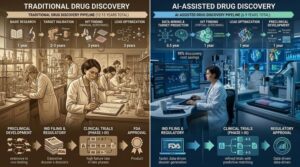
A simplified AI-assisted drug discovery process looks something like this:

Disease → Biological target → AI analysis → Candidate molecules → Laboratory testing → Clinical trials → Approval

AI can help at several points along this journey. It can help researchers identify biological targets, predict how molecules might interact with proteins, design or modify potential drug candidates, and prioritise which compounds should be tested first. This can save researchers enormous amounts of time and laboratory resources.
 

Protein Folding Changed the Game

One of the biggest breakthroughs in this area came from understanding proteins.

Proteins perform many important jobs inside living organisms. Their three-dimensional shapes influence how they work and how potential medicines interact with them.

Predicting these structures has historically been extremely difficult.

AI systems such as AlphaFold demonstrated how machine learning could predict protein structures at remarkable scale. This has given researchers another powerful source of information when investigating diseases and potential treatments.

The significance is bigger than simply “AI can predict proteins.”

It means researchers can increasingly combine biology, chemistry and computation when searching for new medicines.

AI Is Already Being Used in Drug Research

AI drug discovery is no longer just a futuristic idea.

Pharmaceutical companies, biotechnology companies and academic researchers are using machine learning and other computational methods to support research into areas such as:

Cancer

AI can help researchers analyse tumour biology, identify potential drug targets and investigate combinations of treatments.

Antibiotic Resistance

Drug-resistant bacteria are becoming a serious global health challenge. AI can help researchers search for molecules with antibacterial properties, including candidates that may have been difficult to identify using traditional approaches.

Rare Diseases

Some rare diseases have relatively small patient populations, making research difficult and expensive.

AI could help researchers analyse existing biological data and identify potential treatment opportunities more efficiently.

Neurological Diseases

Researchers are using AI to study complex biological systems involved in diseases such as Alzheimer’s and Parkinson’s.

The important point is that AI does not magically cure these diseases.

It helps researchers search, analyse and prioritise.

What AI Cannot Do

This is where some AI headlines become misleading.

AI does not simply create a medicine and send it to a pharmacy.

A promising computer prediction still has to survive reality.

Scientists need to determine whether a candidate actually works, whether it is toxic, how it behaves in the body, what dose is appropriate, and whether it is safe for humans.

Eventually, potential medicines must go through carefully controlled clinical trials and regulatory review.

So the future isn’t really:

AI replaces scientists.

It is closer to:

AI + scientists + laboratories + clinical research.

AI may handle enormous amounts of computation while humans provide scientific judgement, experimentation, safety oversight and accountability.

The Problem With “AI Makes Drugs in Days”

You may see headlines claiming that AI can discover a drug in days or months.

Be careful with those claims.

AI can dramatically accelerate parts of the discovery process, particularly computational screening, prediction and molecule design.

But developing an approved medicine is much bigger than finding a promising molecule.

The candidate still has to be tested.

And testing takes time.

This distinction will become increasingly important between 2026 and 2030, as more AI-designed or AI-assisted drug candidates move through clinical development.

The real opportunity is not necessarily turning a decade-long process into a few days.

It is making the search for promising candidates faster, more targeted and potentially less expensive.

The Next Few Years Could Be Very Interesting

Between 2026 and 2030, expect AI to become more deeply integrated into pharmaceutical research.

We are likely to see:

  • More AI-designed or AI-assisted drug candidates entering clinical trials
  • Better models for predicting molecular interactions
  • Greater use of AI in personalised medicine
  • More integration of genomic, biological and clinical data
  • AI-assisted research into rare and neglected diseases
  • Increasing use of automated laboratory systems alongside AI

The biggest shift may be the combination of AI software with automated laboratories.

Instead of AI simply making a prediction, future systems can increasingly follow a cycle:

Predict → Experiment → Measure → Learn → Predict again

That creates a much faster research loop.

But There Are Serious Questions

More powerful technology also creates difficult questions.

Who owns medicines created with AI?

Will AI-designed treatments be affordable?

Are the datasets used to train these systems representative of different populations?

Could biased or incomplete data produce unreliable predictions?

And if an AI system contributes to a failed treatment, who is responsible?

These questions matter because developing medicine isn’t only a technical challenge.

It is also a human, ethical and economic challenge.

What Does This Mean for Students?

Here’s perhaps the most exciting part.

You don’t have to choose between technology and biology.

The future of medicine will need people who understand both.

Students interested in this field could explore:

  • Python and data science
  • Artificial intelligence and machine learning
  • Biology and genetics
  • Chemistry
  • Biomedical engineering
  • Computational biology
  • Bioinformatics
  • AI ethics

You don’t need to become a drug researcher tomorrow.

Start by learning how computers work, how biological systems work, and how the two can work together.

The Bigger Picture

AI won’t eliminate the need for scientists.

It could make scientists much more capable.

A researcher who once had to spend enormous amounts of time searching through data can increasingly use AI to narrow the possibilities and focus attention on the experiments most worth performing.

That doesn’t mean every AI prediction will be correct.

It means researchers can potentially fail faster, learn faster and find promising ideas sooner.

And when you’re dealing with diseases that affect millions of people, that matters.

The Future of Medicine Is Becoming Computational

The next generation of medicines will not be created by doctors or computers alone.

They will come from a combination of biology, chemistry, computing, engineering and human judgement.

AI is becoming one of the tools researchers use to navigate that complexity.

The question for the next decade isn’t simply whether AI will change medicine.

It already has.

The more interesting question is:

What will scientists discover when AI helps them search where humans couldn’t search before?

Donate

Somewhere in remote Africa, a child is dreaming of an education they can’t afford. Every dollar you donate goes directly toward putting books, teachers, and classrooms in front of students who have none. You’ve already given your time reading this — now consider giving a little more to change a child’s future. No amount is too small; donate below and make your generosity count.

CASHAPP

CashApp Donation

$
  •  
Popular

PayPal

PayPal Donation

$
  •  
Great

Local Transfer

African Donation

$
  •  
Local

Other Links

Launch an App in
48 Hours Using AI

From Idea to Live App in 48 Hours

You’ve got the idea. It’s 2 AM, and you can’t sleep because you keep seeing how it could work—that problem you could solve, that market gap nobody’s filling. You open your laptop with one thought: Can I actually build this thing without hiring a team?

Three years ago, the answer was a hard no. You’d need months, thousands of dollars, and either a co-founder who codes or a willingness to live on ramen while you learned to code yourself.

Today? The answer is yes—and the timeline is measured in days, not months.

The AI revolution didn’t just make coding faster. It fundamentally changed who can build applications. Founders without technical backgrounds are shipping production apps. Solo developers are completing work that used to require three-person teams. And the barrier to validating your idea with real users? It’s never been lower.

But here’s the catch: not all AI tools are created equal. Some generate pretty UI that falls apart the moment you need a database. Others promise the world but require you to be a developer to actually use them. Picking the wrong tool can waste weeks.

So we tested them. We broke them. We built with them. And we’re going to walk you through exactly which tool fits your situation—because your 48-hour app launch depends on it.


The Big Picture: Three Types of AI Builders

Before you choose a tool, you need to understand what you’re actually looking for. AI app builders fall into three camps, and they solve different problems:

1. Full-App Generators are the all-in-one solution. You describe your idea, the AI handles everything—front-end, back-end, database, authentication, even payments. You get a complete, deployed app. If you just want something that works and you want it now, this is your lane.

2. UI-First Generators focus on the visible parts. They’re incredible at turning descriptions into React components and beautiful interfaces, but you’ll still need to wire up the backend yourself or pair them with other tools. Good if you’re design-forward or already have a developer handling infrastructure.

3. Coding Assistants are your co-pilot. They’re not building for you; they’re building with you. If you already code or you have developers on your team, these tools multiply productivity by 3-4x. But they’re not for non-technical founders flying solo.

Most MVP founders need type 1. Let’s start there.


The MVP Dream Team: Full-App Generators That Actually Deliver

Lovable: The Beginner’s Home Run

If you’re non-technical and you’ve never built anything before, Lovable is where you start.

Here’s what makes it special: it’s genuinely friendly. Most AI tools throw you into a code editor and hope for the best. Lovable includes a “Plan Mode” that lets you think through your idea with the AI before any code gets written. You’re literally collaborating with an AI product manager before the engineers build.

The workflow is simple: describe your app (“I want a booking platform for therapists with video call integration and automated reminders”), and Lovable generates a working prototype. Real pages. Real databases. Real workflows that follow the platform’s best practices so you’re not cleaning up AI mistakes later.

Why choose Lovable:

  • Fastest way from zero to working app if you don’t code
  • Your code exports to GitHub, so you’re never locked in
  • The conversational interface feels less like “coding” and more like describing your vision

Real limitation: The AI can handle standard CRUD apps beautifully. If you need unusual backend logic (complex calculations, custom algorithms, integrations with weird APIs), it starts to stumble.

Starting price: Free tier available; pro plans for production hosting and custom domains.

Perfect for: First-time founders, designers who want interactive prototypes, anyone launching their first SaaS side project.


Bolt.new: The Speed Racer

If you measured Lovable on “friendliness,” measure Bolt on pure velocity.

You describe an app. You hit enter. And then you just watch it build in your browser—in real-time. React components rendering. Node.js backend spinning up. PostgreSQL database configured. Then it deploys to Netlify with one click. The whole thing takes 5-15 minutes depending on complexity.

The magic is that Bolt maintains context across your entire conversation. Refine it. Ask for changes. The AI remembers the architecture and doesn’t break things that already work. That sounds obvious, but many AI builders lose track halfway through and start contradicting themselves. Bolt doesn’t.

Why choose Bolt:

  • Fastest path to a deployed, shareable link
  • You can iterate quickly without losing context
  • Great for “think out loud” building where you shape the app as you go

Real limitation: It’s web-only (responsive design works great on phones, but it’s not a native mobile app). And the code stays in Bolt’s environment, though it does compile cleanly if you want to export.

Starting price: Free to start; credits for advanced features.

Perfect for: Rapid prototyping, web MVPs, hackathon projects, teams that want something live today.


NxCode: The Architect’s Choice

Here’s a different approach: what if the AI could think before it built?

NxCode separates planning from implementation. You describe your SaaS idea, and the AI first maps out requirements, data models, and API architecture. Then—and only then—it builds. This means fewer hallucinations, fewer “oh wait, I didn’t think about that” moments.

This tool is built for SaaS founders who need a real backend: user authentication, role-based access control, payment integration, multi-tenant features. It treats those as first-class citizens, not afterthoughts.

Why choose NxCode:

  • Best for SaaS and data-heavy applications
  • The planning phase catches problems before code is written
  • Full-stack from day one (you’re not bolting on auth later)

Real limitation: It’s slightly slower than single-prompt generators because of the planning phase. But the output is more “complete” and closer to production-ready.

Pricing: $5/month (lite) to $20/month (pro), making it one of the most accessible tools.

Perfect for: Founders building SaaS products, anyone who needs real user authentication and roles, CRUD-heavy applications.


Bubble: The No-Code Platform’s AI Glow-Up

If you’ve heard of Bubble before, you know it’s the powerful no-code platform that can handle almost anything. Now it has AI integrated into its DNA.

You can still use Bubble the traditional way (drag-and-drop everything), but with AI you can speed up the parts that used to be tedious. Generate workflow logic. Build database schemas. Hook up integrations.

The real power: Bubble lets you connect to OpenAI, Anthropic, and other LLMs directly. So you’re not just using AI to build your app; you can build AI features into your app. Chatbots. Content generation. Classification engines. All wired up without leaving Bubble.

Why choose Bubble:

  • Most powerful for apps that need complex backend logic
  • Can build AI features directly into your product
  • Visual editor means you can fine-tune anything the AI generates

Real limitation: Steeper learning curve than Lovable or Bolt if you’ve never no-coded before.

Pricing: Plans start at reasonable levels, with pricing based on usage and features.

Perfect for: Builders who want maximum flexibility, anyone planning to add AI features to their app, teams that want to maintain apps long-term.


Atoms: The “Hire a Team” Simulator

Here’s the outlier: what if the AI didn’t try to do everything itself?

Atoms uses multiple AI agents that specialize. One handles requirements. One writes code. Another manages data modeling. They coordinate like a small engineering team. The result is not just faster—it’s more thoughtful.

The tradeoff: it’s slower than hitting “generate app” once. But the output is more complete and catches edge cases that single-prompt generators miss.

Why choose Atoms:

  • Most complete MVP output (closest to “actually production-ready”)
  • Multi-agent approach means smarter architecture decisions
  • Better for complex applications

Real limitation: Takes longer (but still fast by traditional standards). Smaller community than Lovable or Bubble.

Pricing: Free tier for testing; paid for production hosting.

Perfect for: Founders who want the highest-quality MVP possible, applications with complex workflows or integrations, teams that plan to grow the product beyond launch.


The Specialist Tools: UI Generators & Coding Sidekicks

Not everyone needs a full-stack generator. Some situations demand specialists.

v0: If You Just Need the Frontend

v0 is Vercel’s React component generator. You describe an interface, and it generates clean, production-quality React components. You integrate them into your own codebase, wire up your backend, and you’re done.

Perfect for: Developers who have the backend sorted and just need beautiful UI fast. Design teams building interactive mockups.


Cursor: The Developer’s Secret Weapon

Cursor is an IDE built around AI pair-programming. It’s not building for you; it’s sitting in your editor, writing code with you. Want to refactor a function? Describe what you want. Cursor writes it. Want to add a feature? Explain it. The AI codes it.

It multiplies developer productivity by 3-4x, which means an experienced developer can now do what used to take two developers.

Perfect for: Teams with technical people on staff. Not for non-technical founders.


Mobile Native Apps: A Different Beast

Everything we’ve discussed generates web apps (which work great on phones). But if you need native iOS or Android apps for the App Store, you need different tools:

  • CatDoes can go from prompt to App Store/Google Play without code
  • FlutterFlow generates exportable Flutter/Dart code

These are powerful but more specialized. Most startups start with web because it’s 1/3 the work and reaches 90% of users anyway.


The Real Talk: What AI-Built MVPs Can’t Do (Yet)

Let’s be honest about the limitations, because every founder needs to hear this:

AI-generated code is a prototype, not production. That means:

  • It probably doesn’t have error handling for edge cases
  • Security hardening is missing (input validation, rate limiting, etc.)
  • There’s no monitoring, logging, or alerting for production issues
  • Performance at scale hasn’t been tested
  • No automated tests exist

This is fine. Your MVP isn’t supposed to be production-hardened. It’s supposed to validate your idea with real users. Launch it, learn, then invest in hardening once you know people want what you’re building.

But don’t be surprised when you need to add security and infrastructure polish before going from “friends and early adopters” to “actual customers.”


Picking Your Tool: The Decision Tree

Here’s how to actually choose:

Are you non-technical?

  • Yes → Lovable or Bolt.new
  • Want something faster than Lovable? → Bolt.new
  • Want to be more involved and thoughtful? → Lovable

Are you building a SaaS product (not just a simple tool)?

  • Yes → NxCode or Atoms
  • Want it fastest? → NxCode
  • Want it most complete? → Atoms
  • Already love no-code? → Bubble

Do you already have developers?

  • Yes → Cursor (for coding), v0 (for UI), or just use Bolt/Lovable to scaffold and hand off
  • Want your developers 3x more productive? → Cursor
  • Just need UI components? → v0

Do you need native iOS/Android?

  • Yes → CatDoes or FlutterFlow
  • No (web is fine) → Any of the web tools above

The Real Timeline: From Idea to MVP

Here’s what realistic looks like:

  • Day 1, morning: Describe your app to Lovable/Bolt/NxCode
  • Day 1, afternoon: You’re clicking around a working prototype
  • Day 1, evening: You’re making tweaks (add this feature, change that color, fix that logic)
  • Day 2, morning: You’re inviting friends to test it
  • Day 2, afternoon: You’re taking feedback and iterating
  • Day 3-7: You’re recruiting early users, getting their feedback, learning what actually matters
  • Week 2: You’re deciding if this idea has legs or if you pivot

This is the new reality. The question isn’t whether you can build an MVP in 48 hours. The question is whether your idea is worth launching.


One More Thing: The Cost

You might expect this to cost thousands. It doesn’t.

  • Lovable: Free tier to start; $30-50/month for production deployment
  • Bolt.new: Free tier; credits for advanced features
  • NxCode: $5-20/month
  • Bubble: Free tier available; plans scale with usage
  • Cursor: $20/month for the full IDE
  • Figma (for design alongside building): $15/month

Total for a full indie hacker stack? $60-100/month. That’s one hour of freelance developer time. For a tool set that lets you build what used to require hiring someone.


The Uncomfortable Truth About This New Reality

Here’s what’s actually changed:

The hardest part of building an app was never the coding. It was the deciding—what to build, who to build it for, whether anyone cares.

AI tools eliminated the coding barrier. Which means the bottleneck moved. Now the competitive advantage is clarity of thought, understanding your users, and speed of learning.

You can compete now, but not because you learned to code faster. You can compete because you understand your market better than someone with more technical skill but less business sense.

The playing field didn’t level. It tilted toward people with good ideas and clear thinking.


Your Next Move

Pick the tool that matches your situation (use our decision tree above). Spend 30 minutes describing your idea to it. See what it builds.

Then do the hard part: get it in front of real people and learn whether your idea is worth working on.

The ability to build is no longer your limiting factor. Use that gift wisely.

Donate

Somewhere in remote Africa, a child is dreaming of an education they can’t afford. Every dollar you donate goes directly toward putting books, teachers, and classrooms in front of students who have none. You’ve already given your time reading this — now consider giving a little more to change a child’s future. No amount is too small; donate below and make your generosity count.

CASHAPP

CashApp Donation

$
  •  
Popular

PayPal

PayPal Donation

$
  •  
Great

Local Transfer

African Donation

$
  •  
Local

Other Blogs

Add Your Heading Text Here

THE REAL ANNUAL EARNINGS OF TOP CEOs IN 2026

You Would Need 100 Lifetimes to Earn What This CEO Makes in One Year

The FY2024(FISCAL YEAR) CEO pay numbers are in — and they are, frankly, hard to comprehend. We did the math so you don’t have to.

Imagine working every single day for 40 years. A full career — Monday mornings, late Fridays, the whole thing. Now imagine doing that one hundred times over. That’s how long it would take the average Mattel worker to earn what their CEO, Ynon Kreiz, pocketed in a single fiscal year: $37.8 million.

That staggering ratio — 4,028 workers’ lifetimes to match one CEO’s annual pay — topped a recent analysis of SEC proxy filings for FY2024. But Mattel isn’t even close to the most extreme story. Not by a long shot.

 
$197M


What Nvidia’s Jensen Huang earned in 2024 — more than the entire payroll of some small nations

How the Numbers Actually Stack Up

The viral infographic that sparked this deep-dive used “worker lifetimes” as its unit — a clever way to make abstract ratios feel human. Here’s what the real dollar figures behind those ratios look like, pulled directly from SEC filings:

 
Mattel
Ynon Kreiz
$37.8M
100.7 lifetimes · 4,028:1
McDonald’s
Chris Kempczinski
$18.2M
25.4 lifetimes · 1,014:1
MercadoLibre
Marcos Galperin
$13.7M
39.7 lifetimes · 1,589:1
Hilton
Chris Nassetta
$28.0M
14.4 lifetimes · 577:1
Marriott
Anthony Capuano
$21.9M
11.9 lifetimes · 475:1
Apple
Tim Cook
$74.6M
16.3 lifetimes · 650:1
FirstCash
Rick Wessel
$12.1M
26.0 lifetimes · 1,041:1
Nvidia
Jensen Huang
$197.6M

Starbucks

Brian Niccol

$95.8M

Nvidia
Jensen Huang
$197.6M
Starbucks
Brian Niccol
$95.8M
Amazon
Andy Jassy
$40.1M
Meta
Mark Zuckerberg
$24.4M
Alphabet / Google
Sundar Pichai
$10.7M

REALITY CHECK

What $197 million actually looks like: If you earned $50,000 a year and worked without spending a single cent, it would take you 3,952 years to accumulate what Jensen Huang earned in 12 months. Put another way: Jensen Huang earned more in 2024 than the combined annual salaries of every teacher in a mid-sized American school district. Elon Musk's Tesla pay: Officially listed as $0 for 2024 — but he holds a contested $56 billion stock option package approved in 2018 that remains under legal review.
What's undeniable is this: CEO pay jumped nearly 10% in 2024 as profits and stock prices soared, while average U.S. worker wages rose about 3.6%. The gap is not closing. If anything, it is widening with every AI-fueled bull market.

Donate

Somewhere in remote Africa, a child is dreaming of an education they can’t afford. Every dollar you donate goes directly toward putting books, tablets, laptops, teachers, and classrooms in front of students who have none. You’ve already given your time reading this — now consider giving a little more to change a child’s future. No amount is too small; donate below and make your generosity count.

Comment donated when you do.

CASHAPP

CashApp Donation

$
  •  
Popular

PayPal

PayPal Donation

$
  •  
Great

Local Transfer

African Donation

$
  •  
Local

The Income Gap No One Talks About: CEO vs Everyday Workers PART 2

“The Income Gap No One Talks About: CEO vs Everyday Workers”

Why This Matters to You — Even If You're Not a CEO

If You Work for Someone Else:

1. Know your worth — and negotiate like you mean it. Most workers never negotiate their salary. They accept the first offer. They wait to be told they deserve more. But the gap shown in this chart didn’t happen by accident — it grew because those at the top negotiate aggressively, and those at the bottom don’t. Start negotiating every opportunity you get. A 10% raise compounding over a career is worth hundreds of thousands of dollars.

2. Build income outside your job. Your salary is someone else deciding what you’re worth. It’s capped. It can be taken away. The chart shows clearly that the employee-employer relationship is deeply unbalanced at the top. This doesn’t mean your employer is evil — but it is a strong reason to build a side income, invest, or start something small on the side.

3. Invest — because your time has a ceiling, but your money doesn’t. A worker’s income is limited by hours. A CEO’s compensation often includes massive stock awards that grow whether they’re working or sleeping. You can access the same compounding power through investments — even small ones, started early. Time in the market beats timing the market.


If You Run a Business:

1. Pay attention to how you compensate your team. The companies on this chart are facing growing public anger, talent issues, and reputational risk because of extreme pay gaps. You don’t have to be a saint — but treating your people well has a measurable ROI: lower turnover, higher loyalty, stronger culture. Businesses that share value with employees tend to build more durable companies.

2. Your value as a business owner is closer to the CEO than the worker — protect it. The chart also shows what business ownership can unlock. CEOs are compensated like owners because they’re treated like owners. As a business owner, you have something rare: leverage. Your income isn’t purely tied to your hours. Protect that leverage — don’t undercharge, don’t undervalue your offer, and don’t run your business like an underpaid employee of yourself.

3. Build systems, not just services. The reason CEOs earn so much more than workers is leverage — they sit at the top of systems that multiply their decisions. As a small business owner, you can create the same principle at your scale: document your processes, hire or delegate, build things that work without you. The more your business runs on systems rather than just your personal effort, the more your time becomes truly valuable.


The Simple Takeaway

The chart isn’t meant to make you angry (though it might). It’s data showing something important:

The gap between those who own and those who only work is enormous — and it’s growing.

You have a choice about which side of that gap you stand on. Not by becoming a Fortune 500 CEO (most people won’t), but by:

  • Building skills that are rare and valuable
  • Owning assets — investments, a business, property
  • Negotiating your worth instead of accepting whatever you’re given
  • Creating multiple streams of income so no single person controls your financial life

The 40-year worker in that chart isn’t a failure. They showed up. They contributed. But the system rewards ownership and leverage far more than it rewards time and effort alone.

The smartest thing you can do with this information is act on it — starting today, at whatever scale you can.

Donate

Somewhere in remote Africa, a child is dreaming of an education they can’t afford. Every dollar you donate goes directly toward putting books, laptops, tablets, teachers, and classrooms in front of students who have none. You’ve already given your time reading this — now consider giving a little more to change a child’s future. No amount is too small; donate below and make your generosity count.

CASHAPP

CashApp Donation

$
  •  
Popular

PayPal

PayPal Donation

$
  •  
Great

Local Transfer

African Donation

$
  •  
Local

The Income Gap No One Talks About: CEO vs Everyday Workers

“The Income Gap No One Talks About: CEO vs Everyday Workers”

How Many Lifetimes Does It Take to Earn a CEO’s Salary? (And What You Should Do About It)

Imagine working for 40 years… then doing that again… and again… and still not earning what a CEO makes in just one year.

Sounds extreme, right?

But that’s exactly what recent data suggests.

At companies like Mattel, an average worker would need over 100 full careers to match one year of CEO pay.

This isn’t just a statistic. It’s a wake-up call.


What This Really Means

Let’s simplify it.

A “lifetime” in this chart means:

  • 40 years of work
  • At average employee pay

So when you see:

  • 16 lifetimes at Apple
  • 25 lifetimes at McDonald’s

It means:

“If you worked your entire life, you’d need to repeat that life many times to earn what the CEO earns in one year.”

The CEO of Mattel earned more in one single year than you would earn in 100 lifetimes.

That’s not 100 years. That’s 100 entire careers of 40 years each. That’s 4,000 years of working — just to match one year of their pay.

But Don’t Misread This

This is where many people get stuck.

They see this and think:

  • “The system is unfair”
  • “There’s nothing I can do”
  • “Success is out of reach”

That mindset will keep you exactly where you are.

Because here’s the truth:

👉 CEOs are not paid for time
👉 They are paid for scale, decisions, and impact


The Real Lesson Hidden in This Data

This chart is not just about inequality.

It’s about how money actually works at the highest level.

Employees earn:

  • Based on time
  • Based on tasks
  • Based on fixed roles

CEOs earn:

  • Based on decisions
  • Based on company performance
  • Based on ownership (stocks, equity)

That’s a completely different game.


What You Should Do With This Information

Instead of getting discouraged, use this as a strategy shift.

1. Stop thinking only in salaries

A salary has a ceiling.

Even a high-paying job still ties your income to time.


2. Learn high-value skills

Focus on skills that influence outcomes:

  • Tech (development, AI, systems)
  • Sales and marketing
  • Business strategy

These are the same skills that scale income.


3. Build or own something

CEOs earn more because they are tied to ownership and growth.

You don’t have to start big.

Start with:

  • A small business
  • A digital product
  • A service-based brand

4. Think in leverage, not effort

Working harder is not the answer.

Working smarter means:

  • Using systems
  • Using technology
  • Reaching more people at once

Final Thought

This chart is not telling you:

“You’ll never catch up.”

It’s telling you:

“You’re playing a different game.”

If you stay in the “trade time for money” system, the gap will always exist.

But if you shift toward ownership, skills, and leverage, you stop comparing—and start building.

Donate

Somewhere in remote Africa, a child is dreaming of an education they can’t afford. Every dollar you donate goes directly toward putting books, teachers, and classrooms in front of students who have none. You’ve already given your time reading this — now consider giving a little more to change a child’s future. No amount is too small; donate below and make your generosity count.

CASHAPP

CashApp Donation

$
  •  
Popular

PayPal

PayPal Donation

$
  •  
Great

Local Transfer

African Donation

$
  •  
Local