AI Literacy for Kids: What Every Child Should Learn Before Age 10
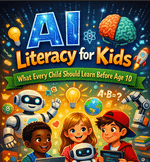
AI Literacy: The New Reading and Writing Your Kids Need Before They Turn 10 AI Literacy: The New Reading and Writing Your Kids Need Before They Turn 10 There was a time when a child who couldn’t read by age 8 was considered behind. Today, we’re heading toward a world where a child who can’t communicate with AI — clearly, critically, and responsibly — will face a similar gap. The question is no longer if your child will use AI. It’s whether they’ll use it well. Picture this: your 9-year-old sits down at a laptop, types a sentence, and — in under three seconds — watches an image spring to life out of thin air. A dragon. On a skateboard. In Lagos traffic. Wearing a dashiki. That’s not magic. That’s a prompt. And the child who typed it just practiced one of the most important skills of the next decade. We’ve spent a lot of time asking “should kids use AI?” We need to start asking a better question: “are we building the foundation they need to use it wisely?” Why Foundation Comes Before Prompting Here’s a trap many parents and educators fall into: they hand a child an AI tool before the child has the mental models to understand what they’re actually doing. The result? The child treats it like Google — or worse, like a vending machine for answers. They take everything it says at face value. They don’t know how to ask better questions. And they miss the entire point. Before a child prompts, they need a foundation in four things. Think of these as the four pillars of AI literacy: Here’s a trap many parents and educators fall into: they hand a child an AI tool before the child has the mental models to understand what they’re actually doing. The result? The child treats it like Google — or worse, like a vending machine for answers. They take everything it says at face value. They don’t know how to ask better questions. And they miss the entire point. Before a child prompts, they need a foundation in four things. Think of these as the four pillars of AI literacy: 🎯 What AI Actually Is AI learns from examples, not from thinking. It doesn’t “know” things the way you do — it predicts patterns. Kids need this mental model first. 🎯 AI Can Be Wrong AI makes things up. Confidently. Teaching kids to verify AI output is like teaching them not to believe everything a stranger says. 🎯 Garbage In, Garbage Out The quality of your prompt determines the quality of your result. Vague instruction = vague output. Precision is a learnable skill. 🎯 AI Reflects Human Bias AI is trained on human-made content — which carries human prejudices. Even kids can begin to spot when an AI result seems unfair or narrow. Once these four ideas are planted — even in simple, age-appropriate ways — a child transforms from a passive consumer of AI output into a thoughtful one. That shift is everything. Learning to Prompt: From Simplest to Strongest Prompting is a skill with levels. You don’t teach a child to write an essay before they learn letters. Same principle applies here. Here’s a clear progression — what I call the Prompt Ladder — that parents and educators can follow: The Noun Prompt — Just Name the Thing Start with the simplest possible instruction. One word or a basic noun phrase. The child sees that AI responds to text. The magic hooks them in immediately. Example prompt: a cat The Describing Prompt — Add Colour and Size Now ask: what does your cat look like? What colour? How big? This is where describing words (adjectives) become exciting tools, not boring grammar. Example prompt a fluffy orange cat sitting on a blue roof The Scene Prompt — Add a World Around It Context makes images richer. What’s happening? Where? What time of day? Children learn that setting and action transform a flat image into a story. Example prompt a fluffy orange cat sitting on a blue roof at sunset, looking at the city below The Style Prompt — Choose How It Looks This is where it gets artistic. Watercolour? Cartoon? Comic book? Pixel art? Kids discover that the same subject looks completely different based on style — and they have total control. Example prompt a fluffy orange cat on a blue Lagos rooftop at sunset, cartoon style, bright colours, children’s book illustration Start Here: The Best First App for Young Prompters Before we get to the showstopper tool (spoiler: it’s Leonardo), there are two gateway apps worth having on your radar for younger children just getting started: Google’s Quick Draw (Ages 5+, Free) This is AI in its most playful form. Kids draw a simple picture and an AI tries to guess what it is. It teaches the single most important concept in AI literacy — that machines recognise patterns, not meaning — in about 20 seconds. And children find it hilarious when it’s wrong. Khan Academy’s Khanmigo (Ages 7+, Free) An AI tutor that answers questions but doesn’t just hand over answers. It asks follow-up questions, adjusts to the child’s level, and models what a good prompt-response loop looks like. Excellent for building conversational AI literacy. Once your child understands the loop — type something, see something, improve it, try again — they’re ready for the real playground. The Magic Tool: Leonardo.AI and the Joy of Text-to-Image Leonardo.AI — Where Words Become Worlds Leonardo is a browser-based AI art generator that turns text descriptions into stunning images. No downloads, no Discord setup needed — and it has become one of the most popular creative AI platforms in the world, recently acquired by Canva. AccessBrowser-based, no install needed Free Tier150 tokens per day Content SafetyNSFW blocked by default Age RuleParent account, supervised use Real Prompts to Try With Your Child on Leonardo Here’s a progression from beginner to advanced that turns a session into a creative journey: Beginnera lion
The resources for learning how to code in Nigeria

The resources for learning how to code in Nigeria The resources for learning how to code in Nigeria In today’s fast-paced, technology-driven world, coding has become an essential skill for success. As Nigeria continues to grow and develop, it’s crucial that our youth are equipped with the skills necessary to thrive in this digital age. That’s why we’re excited to share with you the numerous resources available for learning how to code in Nigeria. Imagine a future where Nigerian youth are at the forefront of innovation, creating cutting-edge solutions to real-world problems. A future where they’re not just consumers of technology, but creators, driving growth and development in our great nation. This future is within reach, and it starts with coding. From online platforms like Codecademy and FreeCodeCamp, to coding bootcamps and training programs like Andela and TechQuest Nigeria, there are numerous resources available to help our youth learn how to code. Additionally, meetups and communities like Nigeria Python Community and Lagos JavaScript Meetup provide opportunities for networking, learning, and growth. As a parent, teacher, school proprietor or proprietress, you play a vital role in shaping the future of our youth. By introducing them to coding, you’re giving them the tools they need to succeed in an increasingly digital world. So why not start their coding journey today? If you’re a parent, teacher, school proprietor or proprietress and you desire to start this coding journey for your child or students, click here now to explore our curated list of resources and take the first step towards unlocking their future. Together, let’s empower the next generation of Nigerian innovators and change-makers! Click here Now Other Links AI app for kids Phoenix Coding Competition AI APP FOR KIDS – The AI… Read More adminNovember 17, 2025 meta ai free tier features and limits 2025 Meta AI Free Tier in 2025 Meta AI Free Tier… Read More adminNovember 17, 2025 11 Smart AI Apps That Are Helping Children With Their Assignments Around the World 11 Smart AI Apps That Are Helping Children With Their… Read More adminJuly 12, 2025 31 Companies Transitioning to AI in 2025: Free Tools and Features to Explore 31 Companies Transitioning to AI In 2025 31 Companies Transitioning… Read More adminJuly 6, 2025 Load More Donate Somewhere in remote Africa, a child is dreaming of an education they can’t afford. Every dollar you donate goes directly toward putting books, teachers, and classrooms in front of students who have none. You’ve already given your time reading this — now consider giving a little more to change a child’s future. No amount is too small; donate below and make your generosity count. CASHAPP CashApp Donation $ 5181884036149 Popular PayPal PayPal Donation $ chrisklem30@gmail.com Great Local Transfer African Donation $ Paystack-Titan: 9719443563 Local
How Coding Can Solve Real-Life Problems in Nigeria
How Coding Can Solve Real-Life Problems in Nigeria How Coding Can Solve Real-Life Problems in Nigeria Nigeria, a land of vibrant culture, resilient people, and untapped potential. But beneath the surface, lies a plethora of challenges that hinder progress. From inefficient healthcare systems to crippling traffic congestion, Nigerians face numerous real-life problems daily. However, there’s hope. Coding, the language of innovation, can be the game-changer Nigeria needs. Healthcare Accessibility Imagine a pregnant woman in rural Nigeria, struggling to access quality healthcare. Coding can bridge this gap. Telemedicine platforms, built by Nigerian developers, can connect patients with doctors remotely. Apps like “Dial-a-Doctor” already provide virtual consultations, reducing maternal mortality rates. Traffic Congestion Lagos, Nigeria’s economic hub, is notorious for gridlocks. Coding can optimize traffic flow. Intelligent transportation systems, utilizing real-time data and algorithms, can manage traffic lights and reduce congestion. Financial Inclusion Millions of Nigerians remain unbanked, excluded from financial opportunities. Coding enables innovative solutions. Mobile banking apps, such as “Paga” and “Opay“, provide financial services to underserved communities. Education Nigeria’s education sector faces numerous challenges. Coding can enhance learning experiences. E-learning platforms, like “Tuteria” and “Roducate“, offer accessible, quality education. Food Security Nigeria’s agricultural sector struggles with inefficiencies. Coding can streamline farm-to-table processes. Platforms like “Farmcrowdy” connect farmers with investors, improving food production and distribution. Coding is not just a technical skill; it’s a tool for change. By harnessing technology, Nigerian developers can create solutions that transform lives. Let’s empower the next generation of coders to tackle real-life problems. If you’re a parent, school owner, or teacher who wants pupils and students to start their coding journey, click here to get started! Other Links AI app for kids Phoenix Coding Competition AI APP FOR KIDS – The AI… Read More adminNovember 17, 2025 meta ai free tier features and limits 2025 Meta AI Free Tier in 2025 Meta AI Free Tier… Read More adminNovember 17, 2025 11 Smart AI Apps That Are Helping Children With Their Assignments Around the World 11 Smart AI Apps That Are Helping Children With Their… Read More adminJuly 12, 2025 31 Companies Transitioning to AI in 2025: Free Tools and Features to Explore 31 Companies Transitioning to AI In 2025 31 Companies Transitioning… Read More adminJuly 6, 2025 Load More Donate Somewhere in remote Africa, a child is dreaming of an education they can’t afford. Every dollar you donate goes directly toward putting books, teachers, and classrooms in front of students who have none. You’ve already given your time reading this — now consider giving a little more to change a child’s future. No amount is too small; donate below and make your generosity count. CASHAPP CashApp Donation $ 5181884036149 Popular PayPal PayPal Donation $ chrisklem30@gmail.com Great Local Transfer African Donation $ Paystack-Titan: 9719443563 Local